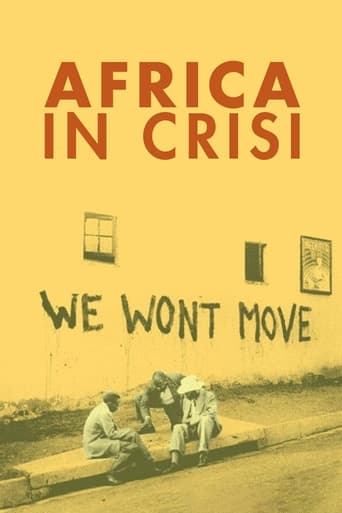
Africa in crisi (1959)
Come Back, Africa
Come Back, Africa chronicles the life of Zachariah, a black South African living under the rule of the harsh apartheid government in 1959.
- Data di uscita
- 1959-09-01
- TMDB
- 6.8 / 10 (16)
- Durata
- 1 h 35 min
- Generi
- Dramma
- Regista
- Lionel Rogosin
Cast
- Miriam Makeba — Miriam
- Vinah Makeba — Vinah
- Zachria Makeba — Zachariah
- Molly Parkin
Curiosità
- Girato a: Sudafrica
Come Back, Africa is a 1959 film, the second feature-length film written, produced, and directed by American independent filmmaker Lionel Rogosin. The film had a profound effect on South African cinema, and remains historically and culturally important as a document preserving the heritage of the townships in South Africa in the 1950s. It may be classified as reportage, documentary, historical or political cinema, since it portrays real events and people. It reveals an interpretation of meaningful social facts and a strong ethical assumption towards human behaviours like racism.
Filming
After the Second World War, Rogosin wanted to make a film that would expose the apartheid system to the world. He made his first film On the Bowery (1956) as a way to prepare for making Come Back, Africa.
Rogosin and his wife Elinor arrived in South Africa in May 1957, and spent six months preparing and getting to know the people and country. He secretly met Myrtle and Marty Berman (organizers in the anti-apartheid movement) who introduced him to the groups fighting against apartheid and to Bloke Modisane, a writer and journalist working for Drum magazine.
Rogosin, Modisane and Nkosis worked out a simple script with which Rogosin improvised and worked with non-professional actors. The filming was done under the danger of being discovered by the apartheid regime. Rogosin carefully made up different stories for different people so that he was able to film and get the materials out of the country safely.
Rogosin's crew worked in secret, disguised as a commercial film unit making a musical, and in constant fear of confiscation and deportation. It was one of the first non-musical films, if not the first to document the lives of black people in Africa using native languages.
The South African government attacked Come Back, Africa and banned it from being shown in South Africa.
Leggi su Wikipedia · Testo da Wikipedia, CC BY-SA 4.0. Dati da Wikidata.
Consigliati
- Grido di libertà 1987 · ★ 7.0
- Sarafina! - Il profumo della libertà 1992 · ★ 6.2
- Un'arida stagione bianca 2008 · ★ 6.2
- Skin 2009 · ★ 6.4
- Escape from Pretoria 2020 · ★ 7.2
- Catch a fire 2006 · ★ 6.3
- Invictus - L'invincibile 2009 · ★ 7.2
- The Bang Bang Club 2011 · ★ 6.6
- La classe operaia va in paradiso 1971 · ★ 7.8
- Shepherds and Butchers 2016 · ★ 6.3
- Hardball 2001 · ★ 6.5
- Violenza per una giovane 1960 · ★ 7.0