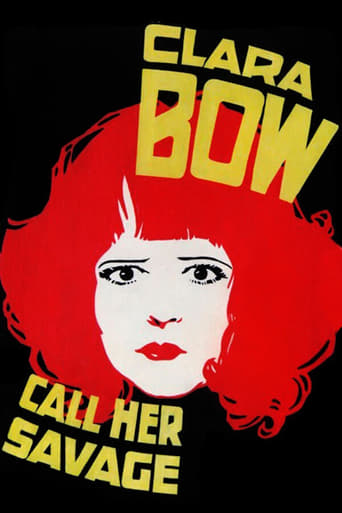
Call Her Savage (1932)
A high-spirited and short-tempered Texan woman storms her way through life until her luck runs out, forcing her to learn the error of her ways.
- Data de estreia
- 1932-11-24
- TMDB
- 5.7 / 10 (26)
- Duração
- 1 h 28 min
- Géneros
- Drama
- Realizador
- John Francis Dillon
Elenco
- Clara Bow — Nasa Springer
- Gilbert Roland — Moonglow
- Thelma Todd — Sunny De Lane
- Monroe Owsley — Lawrence Crosby
- Estelle Taylor — Ruth Springer
- Weldon Heyburn — Ronasa
- Willard Robertson — Pete Springer
- Anthony Jowitt — Jay Randall
- Fred Kohler — Silas Jennings
- Russell Simpson — Old Man in Wagon Train
- Margaret Livingston — Molly
- Carl Stockdale — Mort
Curiosidades
Call Her Savage, is a 1932 American pre-Code drama film directed by John Francis Dillon. The film was based on the book of the same name by Tiffany Thayer, which contains themes of promiscuity, sadism, and lesbianism.
Background and production
The film marked Bow's first return to the screen after she had experienced a nervous breakdown, and took a temporary leave of absence from appearing in any films. In her new contract with Fox Films, Bow negotiated more control over her return. Bow negotiated a salary of $75,000 (equivalent to $1,724,451 in 2024), for her return to the screen, and a $25,000 bonus if the picture grossed over $800,000.
Fox reopened its unused Western Avenue studios for the shooting, and John Francis Dillon, the director, was hired with her approval, and after testing Joel McCrea as a favor to her husband Rex Bell, she instead chose Gilbert Roland for her leading man.
Bow personally selected the novel, Call Her Savage, by Tiffany Thayer to be adapted for her first project with Fox. Sam Rork then bought the rights from Thayer, and in turn sold it to Fox. Jason Joy, who was head of the Hays committee at the time, said the "book is about as far wrong as it is possible to be", due to the novel having themes of incest, masturbation, transvestism, venereal disease, and being "patently racist".
When the first draft of the project was completed, Joy observed that the writer had taken "most of the real flavor of the story" out of it, which resulted in just "another stupid movie was in prospect". So Rork worked with Al Rockett and Edwin Burker to refine the story, which resulted in adding back more of the racier content into the screenplay.
One scene that was not cut, which is widely considered to be the first depiction of a gay bar in a pre-Code American film, is where Bow is out on the town in New York "slumming" it up with a gigolo, and when Bow asks where they are going, he replies: "down in the Village where only wild poets and anarchists eat." According to LGBTQ film historian Vito Russo, the lyrics from the song the two "willowy young men" are performing in the scene at the b…
Ler na Wikipédia · Texto da Wikipédia, CC BY-SA 4.0. Dados do Wikidata.
Recomendados
- I Believe in Unicorns 2015 · ★ 6.7
- Forty Guns 1957 · ★ 6.6
- Castelos de Gelo 2010 · ★ 6.3
- Lady Driver 2020 · ★ 6.4
- A Luta por um Ideal 2012 · ★ 6.2
- Eleanor the Great 2025 · ★ 6.8
- Hud 1963 · ★ 7.3
- Flicka 2006 · ★ 6.9
- The Trip to Bountiful 1985 · ★ 7.2
- All Together Now 2020 · ★ 6.7
- River of Grass 1995 · ★ 6.2
- Um Jogador de Sonho 2021 · ★ 7.1