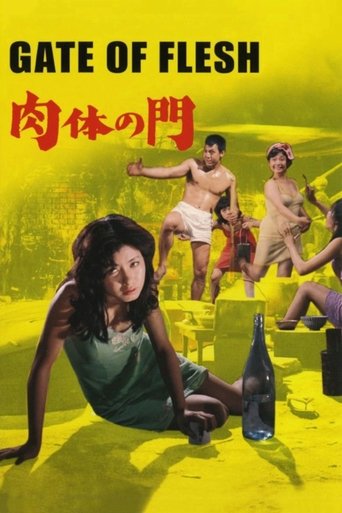
Gate of Flesh (1964)
肉体の門
In the shady black markets and bombed-out hovels of post–World War II Tokyo, a tough band of prostitutes eke out a dog-eat-dog existence, maintaining tenuous friendships and a semblance of order in a world of chaos. But when a renegade ex-soldier stumbles into their midst, lusts and loyalties clash, with tragic results. With Gate of Flesh, visionary director Seijun Suzuki delivers a whirlwind of social critique and pulp drama, shot through with brilliant colors and raw emotions.
- Date of release
- 1964-05-31
- TMDB
- 6.6 / 10 (78)
- Runtime
- 1h 30m
- Genres
- Drama, Crime
- Director
- Seijun Suzuki
Casting
- Joe Shishido — Shintaro Ibuki
- Kōji Wada — Abe
- Yumiko Nogawa — Maya
- Tomiko Ishii — Oroku
- Kayo Matsuo — Omino
- Satoko Kasai — Sen
- Misako Tominaga — Machiko
- Isao Tamagawa — Horidome
- Chico Lourant — Black Pastor
- Eimei Esumi — Ogasawara
- Hiroshi Chō — Potato Seller
- Keisuke Noro — Ishii
Interesting facts
- Based on: Nikutai no Mon
Gate of Flesh is a 1964 Japanese film based on a novel by Taijiro Tamura and directed by Seijun Suzuki. The first of Suzuki's "flesh trilogy", the series is considered the "crowning achievement" of his period working at the production house Nikkatsu. The film is viewed as a direct and allegorical critique of Japan's Occupation and subsequent development, which rather than breaking with the country's pre-war militaristic, authoritarian social structures only sees their reconstitution in the post-war period.
Production
Planned as an "adult release" (Japanese films were classified by the country's film board as "general release" or "adult"), the usual pace of production at Nikkatsu (10 days pre-production, 25 days shooting, three days post-production) allowed Suzuki and his innovative production designer Takeo Kimura precious little time to construct sets to recreate post-war firebombed Tokyo.
Most female actresses at Nikkatsu refused to work in the film due to the nudity and subject matter, so the cast's female roles were filled by actresses from outside the studio.
Read on Wikipedia · Text from Wikipedia, CC BY-SA 4.0. Data from Wikidata.
Recommended
- Battles Without Honor and Humanity 1973 · ★ 7.3
- Pigs and Battleships 1961 · ★ 7.2
- Battles Without Honor and Humanity: Deadly Fight in Hiroshima 1973 · ★ 7.3
- Sex and Fury 1973 · ★ 6.2
- Tokyo Decadence 1992 · ★ 6.0
- The Valachi Papers 1972 · ★ 6.5
- Female Yakuza Tale 1973 · ★ 6.1
- Enter the Void 2010 · ★ 7.3
- Vice Squad 1982 · ★ 6.2
- The Protector 1985 · ★ 5.9
- Kill Bill: The Whole Bloody Affair 2011 · ★ 8.1
- Foxy Brown 1974 · ★ 6.3