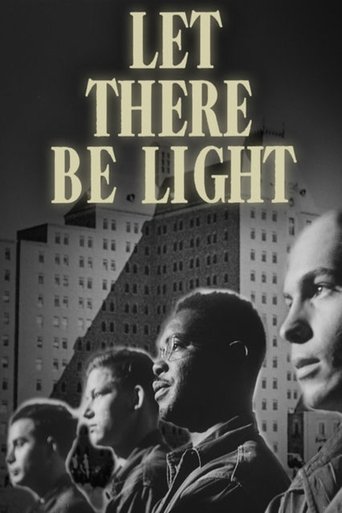
E la luce fu (1946)
Let There Be Light
Girato interamente in un ospedale psichiatrico proprio poco dopo la fine della Seconda guerra mondiale, il documentario del giovane Huston, racconta i problemi dei veterani di ritorno dalla guerra - sindrome da disturbo post-traumatico e altri disordini neurologici legati all'esposizione al conflitto - descrivendo i sintomi e le eventuali cure.
- Data di uscita
- 1946-12-16
- TMDB
- 7.3 / 10 (48)
- Durata
- 58 min
- Generi
- Documentario, Guerra
- Regista
- John Huston
Cast
- Walter Huston — Narrator (voice) (uncredited)
Curiosità
Let There Be Light is a documentary film directed by American filmmaker John Huston (1906–1987). It was the last in a series of four films directed by Huston while serving in the U.S. Army Signal Corps during World War II. The film was produced in 1946 and was intended to educate the public about post-traumatic stress disorder and its treatment among returning veterans, but its unscripted presentation of mental disability caused the U.S. government to suppress the film, and it was not released until the 1980s.
Production
The film was made as one of the early entries in the Army's Professional Medical Film series, which began in 1945. It was shot during Spring 1945 at Edgewood State Hospital, Deer Park, Long Island, New York, which between 1944 and 1946 was part of Mason General Hospital, a psychiatric hospital run by the War Department and named for an Army doctor and general.
There are no personal credits in the film. Offscreen credits have been compiled by several sources. The film includes scoring by Dimitri Tiomkin. The cinematography has been credited to Stanley Cortez, John Doran, Lloyd Fromm, Joseph Jackman and George Smith. The film's editors were William H. Reynolds and Gene Fowler Jr.
The film crew shot about 375,000 feet of film–close to 70 hours of film. The final product was edited down to less than one hour.
Instead of hindering treatment, the cameras actually seemed to have a stimulating effect on the patients. Patients who were filmed showed greater progress in recovering than those who were not. This is an example of the Hawthorne effect, in which patients respond better when they are observed.
The documentary was revolutionary for its time with its use of unscripted but real footage of interviews. Huston placed hidden cameras in the doctor-patient interview rooms, one focused on the doctor and the other focused on the patient. This style of showing raw emotion would not be replicated in documentaries for at least another decade. Another unusual aspect of the film was its integration of blacks with whites.
Leggi su Wikipedia · Testo da Wikipedia, CC BY-SA 4.0. Dati da Wikidata.
Consigliati
- Padre soldato figlio 2020 · ★ 6.5
- 2000 metri ad Andriivka 2025 · ★ 8.1
- Korengal 2014 · ★ 6.6
- Preludio alla guerra 1942 · ★ 6.4
- Alla mia piccola Sama 2019 · ★ 8.2
- A Toxic Love Story: Il caso Michelle Hadley 2026 · ★ 6.4
- The Battle of San Pietro 1945 · ★ 6.1
- The Soviet Story 2008 · ★ 7.3
- Maternal Instinct: Il caso Taylor Parker 2026 · ★ 7.2
- The Age of Stupid 2009 · ★ 6.6
- Restrepo - Inferno in Afghanistan 2010 · ★ 7.2
- 20 Days in Mariupol 2023 · ★ 8.1