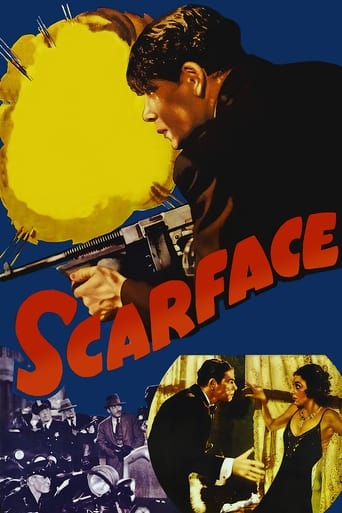
Scarface (1932)
The rise and fall of a power hungry mobster.
In 1920s Chicago, Italian immigrant and notorious thug, Antonio 'Tony' Camonte, aka Scarface, shoots his way to the top of the mobs while trying to protect his sister from the criminal life.
- Date of release
- 1932-04-09
- TMDB
- 7.4 / 10 (738)
- Runtime
- 1h 33m
- Genres
- Crime, Action, Drama, Thriller
- Director
- Howard Hawks
Casting
- Paul Muni — Antonio 'Tony' Camonte
- Ann Dvorak — Francesca 'Cesca' Camonte
- Karen Morley — Poppy
- Osgood Perkins — John 'Johnny' Lovo
- C. Henry Gordon — Insp. Ben Guarino
- George Raft — Guino Rinaldo
- Vince Barnett — Angelo
- Boris Karloff — Gaffney
- Purnell Pratt — Mr. Garston, publisher
- Tully Marshall — Managing Editor
- Inez Palange — Mrs. Camonte
- Edwin Maxwell — Chief of Detectives
Interesting facts
- Budget: $800K
- Based on: Scarface
- Awards: 1 · Nominations: 0. Including: National Board of Review: Top Ten Films
Scarface is a 1932 American gangster film directed by Howard Hawks and produced by Hawks and Howard Hughes. The screenplay is based loosely on the 1930 novel by Armitage Trail, which in turn was inspired by the life of Al Capone. The pre-Code film stars Paul Muni as Italian immigrant gangster Antonio "Tony" Camonte who violently rises through the Chicago gangland, with a supporting cast that includes George Raft and Boris Karloff. Camonte's rise to power dovetails with his relentless pursuit of his boss's mistress while his sister pursues his best hitman. In an overt tie to the life of Capone, a version of the Saint Valentine's Day Massacre is depicted.
Production
Business tycoon Howard Hughes, then involved in film-making, wanted a box-office hit after the success of his 1931 film The Front Page. Gangster films were topical in the early 1930s in the age of Prohibition. Hughes wanted to make a film based on the life of gangster Al Capone superior to all other films in the genre. He was advised against making the film, as the genre was crowded; Little Caesar starring Edward G.
Hughes bought the rights to Armitage Trail's novel Scarface, inspired by the life of Capone. Trail wrote for many detective story magazines during the early 1920s, but died of a heart attack at the age of 28, shortly before the release of Scarface. Hughes hired Fred Pasley, a New York reporter and authority on Capone, as a writer.
Hughes wanted film director Howard Hawks to direct and co-produce. This surprised Hawks, as the two had never been friendly; Hughes had filed a lawsuit against Howard Hawks in July 1930, alleging that Hawks's film The Dawn Patrol had plagiarized his film Hell's Angels. Over a game of golf, Hughes promised to drop the lawsuit (irrelevant as the judge had already dismissed it). By the 18th hole, Hawks had become interested in directing the film.
Hecht wrote the screenplay in 11 days in January 1931, adapted from Trail's novel. Fred Pasley provided additional writing, as well as W. R. Burnett, author of the novel Little Caesar. Pasley's contributions included elements of the book Al Capone: Biography of a Self-Made Man; the book contains a barbershop scene with Capone similar to the introduction of Tony Camonte in the film. Pasley was not credited for his work on the screenplay.
Because there were five writers, it is difficult to distinguish which components were contributed by which writer; however, the ending of Scarface is similar to Hecht's first gangster film Underworld, in which gangster Bull Weed traps himself in his apartment with his lover and fires at the hordes of police outside, and thus was likely a Hecht contribution.
Read on Wikipedia · Text from Wikipedia, CC BY-SA 4.0. Data from Wikidata.
Recommended
- Capone 1975 · ★ 5.9
- Back Roads 2019 · ★ 5.9
- Al Capone 1959 · ★ 6.6
- The Outfit 2022 · ★ 7.1
- The Bikeriders 2024 · ★ 6.7
- Gangster Squad 2013 · ★ 6.4
- Shaft 2000 · ★ 6.0
- Gloria 1980 · ★ 6.9
- Next of Kin 1989 · ★ 5.9
- State Property 2002 · ★ 6.4
- A Walk Among the Tombstones 2014 · ★ 6.3
- Lawless 2012 · ★ 7.1