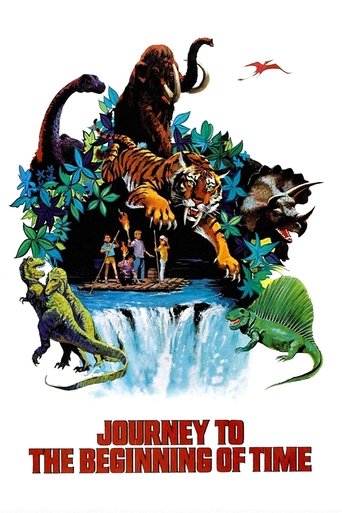
Journey to the Beginning of Time (1955)
Cesta do pravěku
Four boys living the excitement every boy dreams about!
Four schoolboys go on an awe-inspiring expedition back through time, where they behold landscapes and creatures that have long since vanished from the earth.
- Date of release
- 1955-08-05
- TMDB
- 7.2 / 10 (83)
- Runtime
- 1h 25m
- Genres
- Adventure, Fantasy, Family, Science Fiction
- Director
- Karel Zeman
Casting
- Vladimír Bejval — Jirka
- Petr Herrmann — Toník
- Josef Lukáš — Petr
- Zdeněk Husták — Jenda
- Bedřich Šetena — Petr (voice) / Narrator (voice)
Interesting facts
Journey to the Beginning of Time is a 1955 Czechoslovak science fiction adventure directed by Karel Zeman, produced in colour using a combination of 2-D and 3-D models. It was the first of Zeman's productions to include actors in conjunction with stop-motion and special effects. It won awards at the International Film Festivals of Venice and Mannheim. In 1966, Cesta do pravěku was dubbed into English, creating a modified US version, Journey to the Beginning of Time.
Production
Zeman's use of unorthodox and seamless production techniques ensured that the film was free of jerky stop-motion sequences and grainy splicing of stop-motion with real-time footage that characterised Hollywood's animated films until the advent of computer-generated imagery.
Zeman was heavily influenced by the palaeo-art of the celebrated Czech artist Zdeněk Burian (1905-1981), and much of the film's imagery was inspired by Burian reconstructions that had been painted under the guidance of Czech palaeontologist Josef Augusta (1903-1968).
In addition to numerous miniature animal models and 2-D 'profiles', Zeman also used larger models of heads and bodies of animals (including a full-sized 'dead' Stegosaurus and swimming woolly rhinoceros, Brontosaurus and Trachodon models), as well as life-sized model plants (as in the Carboniferous forest sequence, and the encounter with the Styracosaurus).
Cesta do pravěku was made on what would be considered a small budget by Western film-makers. It discussed the various time epochs as defined by palaeontologists and the types of animals typical of those periods, using information known in the 1950s.
In 1966, another version of the film was released in the U.S. by William Cayton whose company had been marketing Russian animated cartoons and feature films from the 1940s and 1950s, especially those of the famous Soyuzmultfilm studios (well known titles included The Firebird, The Frog Prince, Beauty & the Beast, The Space Explorers, and The Twelve Months).
Read on Wikipedia · Text from Wikipedia, CC BY-SA 4.0. Data from Wikidata.
Recommended
- Creature from the Black Lagoon 1954 · ★ 6.8
- Extinct 2021 · ★ 6.2
- Dino Time 2012 · ★ 6.0
- Journey to the Center of the Earth 2008 · ★ 6.1
- The Adam Project 2022 · ★ 7.0
- The Time Machine 2002 · ★ 6.4
- We're Back! A Dinosaur's Story 1993 · ★ 6.1
- The Last Mimzy 2007 · ★ 6.3
- Anastasia: Once Upon a Time 2020 · ★ 5.9
- Time Bandits 1981 · ★ 6.6
- Bill & Ted's Excellent Adventure 1989 · ★ 6.8
- Journey to the Center of the Earth 1959 · ★ 6.9