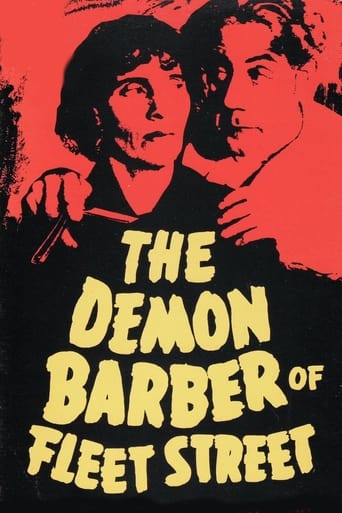
Sweeney Todd, the Demon Barber of Fleet Street (1936)
Brownbeards, Blackbeards, Redbeards. He Polished Them All Off!
It is England in the 1830s. London's dockside is teeming with ships and sailors who have made their fortune in foreign lands. Sweeney Todd, a Fleet Street barber, awaits the arrival of men whose first port of call is for a good, close shave. For most it will be the last time they are seen alive. Using a specially designed barber's chair, Sweeney Todd despatches his victims to the cellar below, where he robs them of their new found fortunes and chops their remains into small pieces. Meanwhile, Mrs Lovett is enjoying a roaring trade for her popular penny meat pies.
- Date of release
- 1936-03-01
- TMDB
- 5.7 / 10 (53)
- Runtime
- 1h 16m
- Genres
- Drama, Crime, Horror
- Director
- George King
Casting
- Tod Slaughter — Sweeney Todd
- Stella Rho — Mrs Lovatt
- John Singer — Tobias Rag
- Eve Lister — Johanna Oakle
- Bruce Seton — Mark
- D.J. Williams — Stephen Oakley
- Davina Whitehouse — Nan
- Jerry Verno — Pearley
- Graham Soutten — Beadle (as Ben Souten)
- Billy Holland — Mr. Parsons
- Norman Pierce — Mr. Findlay
- Aubrey Mallalieu — Trader Paterson
Interesting facts
- Based on: The String of Pearls or the Fiend of Fleet Street
Sweeney Todd: The Demon Barber of Fleet Street is a 1936 British drama film produced and directed by George King, and written by Frederick Hayward, H. F. Maltby, and George Dibdin-Pitt. The film features actor Tod Slaughter as the barber Sweeney Todd.
Production and style
Prior to the film, two previous adaptations of the character were produced in the United Kingdom. The first was Sweeney Todd from 1926 starring G.A. Baughan and again in 1928 with Moore Marriott as Sweeney Todd.
In The Unknown 30s: An Alternative History of the British Cinema 1929-1939 (1998), Jeffrey Richards stated the film was a simplified version of the story dramatized by George Dibdin-Pitt, noting that the story is simplified with events rearranged and some character eliminated. Richards stated what was kept was the familiar melodramatic elements including secret passages, disguises and star-crossed lovers.
Author Ian Conrich noted that British horror cinema is often absent from historical discourse in 1930s films, and not usually acknowledged until film companies like Hammer Films developed their work in the late 1950s. Conrich stated there were no true horror films of the era, but films that had a "horrific" nature that were predominantly comedies, thrillers or melodramas.
Read on Wikipedia · Text from Wikipedia, CC BY-SA 4.0. Data from Wikidata.
Recommended
- Footsteps in the Fog 1955 · ★ 7.0
- A Talent for Murder 2026 · ★ 7.2
- The Parts You Lose 2019 · ★ 6.6
- Winged Creatures 2009 · ★ 5.9
- Perfect Sisters 2014 · ★ 5.8
- Montana 2014 · ★ 6.1
- Sherlock: The Abominable Bride 2016 · ★ 7.8
- No One Would Tell 1996 · ★ 7.0
- Before and After 1996 · ★ 5.9
- The Tomb of Ligeia 1964 · ★ 6.4
- Murder in Three Acts 1986 · ★ 6.0
- The Face Behind the Mask 1941 · ★ 6.5