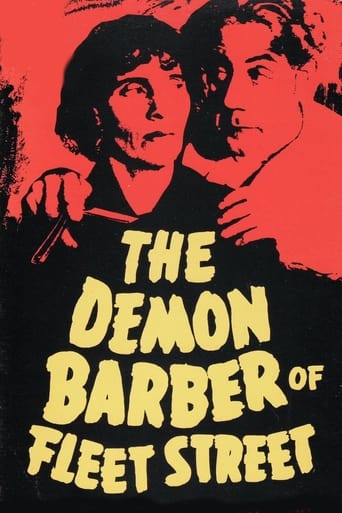
Sweeney Todd: The Demon Barber of Fleet Street (1936)
Sweeney Todd, the Demon Barber of Fleet Street
Primera versión sonora sobre el mito popular Sweeney Todd, barbero asesino que degollaba y robaba a sus victimas en complicidad con su vecina, la señora Lovett que los hacía desaparecer como pasteles de carne. Adapta la pieza teatral de George Dibdin-Pitt de 1847 a mayor gloria del divo Tod Slaughter, que representó al personaje por más de cuatro mil representaciones y resulta un buen ejemplo del terror puramente británico de los años 30 de siglo XX. En 1979 la historia sería reconvertida en un siniestro y memorable musical por Stephen Sondheim, basado a su vez en una obra precedente de Christopher Bond de 1973.
- Fecha de estreno
- 1936-03-01
- TMDB
- 5.7 / 10 (53)
- Duración
- 2 h 0 min
- Géneros
- Drama, Crimen, Terror
- Director
- George King
Reparto
- Tod Slaughter — Sweeney Todd
- Stella Rho — Mrs Lovatt
- John Singer — Tobias Rag
- Eve Lister — Johanna Oakle
- Bruce Seton — Mark
- D.J. Williams — Stephen Oakley
- Davina Whitehouse — Nan
- Jerry Verno — Pearley
- Graham Soutten — Beadle (as Ben Souten)
- Billy Holland — Mr. Parsons
- Norman Pierce — Mr. Findlay
- Aubrey Mallalieu — Trader Paterson
Curiosidades
- Basada en: The String of Pearls or the Fiend of Fleet Street
Sweeney Todd: The Demon Barber of Fleet Street is a 1936 British drama film produced and directed by George King, and written by Frederick Hayward, H. F. Maltby, and George Dibdin-Pitt. The film features actor Tod Slaughter as the barber Sweeney Todd.
Production and style
Prior to the film, two previous adaptations of the character were produced in the United Kingdom. The first was Sweeney Todd from 1926 starring G.A. Baughan and again in 1928 with Moore Marriott as Sweeney Todd.
In The Unknown 30s: An Alternative History of the British Cinema 1929-1939 (1998), Jeffrey Richards stated the film was a simplified version of the story dramatized by George Dibdin-Pitt, noting that the story is simplified with events rearranged and some character eliminated. Richards stated what was kept was the familiar melodramatic elements including secret passages, disguises and star-crossed lovers.
Author Ian Conrich noted that British horror cinema is often absent from historical discourse in 1930s films, and not usually acknowledged until film companies like Hammer Films developed their work in the late 1950s. Conrich stated there were no true horror films of the era, but films that had a "horrific" nature that were predominantly comedies, thrillers or melodramas.
Leer en Wikipedia · Texto de Wikipedia, CC BY-SA 4.0. Datos de Wikidata.
Recomendadas
- Pasos en la niebla 1955 · ★ 7.0
- Talento para matar 2026 · ★ 7.2
- Conspiración en Berlín 1966 · ★ 5.9
- El impostor 1997 · ★ 6.0
- Vidas en pedazos 2019 · ★ 6.6
- Fragmentos 2009 · ★ 5.9
- Perfect Sisters 2014 · ★ 5.8
- Montana 2014 · ★ 6.1
- Sherlock: la novia abominable 2016 · ★ 7.8
- No One Would Tell 1996 · ★ 7.0
- Antes y después 1996 · ★ 5.9
- Mientras el lobo no está 2017 · ★ 8.0