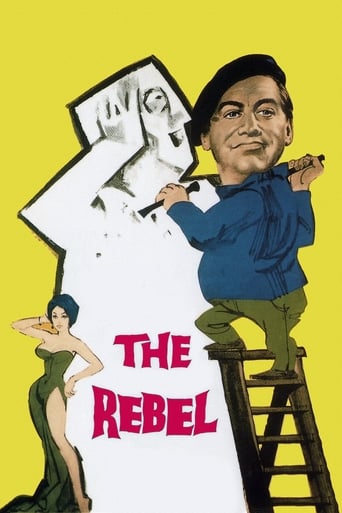
The Rebel (1961)
Anthony Hancock gibt seinen Bürojob auf, um abstrakter Künstler zu werden. Er ist zwar voller Begeisterung, besitzt jedoch kaum Talent, und die Kritiker verachten seine Werke. Dennoch beeindruckt er einen aufstrebenden, hochtalentierten Künstler. Schließlich gelingt es Hancock, die Kunstwelt davon zu überzeugen, dass er ein Genie ist.
- Erscheinungsdatum
- 1961-03-07
- TMDB
- 7.8 / 10 (28)
- Laufzeit
- 1 Std. 45 Min.
- Genres
- Komödie
- Regie
- Robert Day
Besetzung
- Tony Hancock — Anthony Hancock
- George Sanders — Sir Charles Broward
- Dennis Price — Jim Smith
- John Le Mesurier — Office manager
- Irene Handl — Mrs. Crevatte
- Paul Massie — Paul Ashby
- Marie Devereux — Yvette
- Margit Saad — Margot Carreras
- Grégoire Aslan — Aristotle Carreras
- Liz Fraser — Waitress
- Mervyn Johns — Manager of Art Gallery, London
- Peter Bull — Manager of Art Gallery, Paris
Wissenswertes
The Rebel is a 1961 British satirical comedy film directed by Robert Day and starring Tony Hancock. It was written by Ray Galton and Alan Simpson. The film concerns the clash between bourgeois and bohemian cultures.
Production and themes
The film was made by Associated British Picture Corporation and distributed by Warner-Pathé (ABPC's distribution arm).
The Rebel attempts to transfer Hancock's radio and television comedy persona to the big screen, and several regular supporting cast members of Hancock's Half Hour also appeared, including John Le Mesurier, Liz Fraser and Mario Fabrizi. The since-demolished railway station used at the beginning of the film, was Bingham Road in the Croydon suburb of Addiscombe, named Fortune Green South for the film.
The theme of railway station commuters' regimentation and dress codes had been depicted before. In his 1898 work "The Return", Joseph Conrad wrote: "Their backs appeared alike—almost as if they had been wearing a uniform". Hancock told the identically-dressed existentialists that before becoming one himself, he had worn a uniform as a commuter.
In The Rebel, existentialist themes are explored by mocking Parisian intellectual life and portraying the pretensions of the English middle class. Galton and Simpson had previously satirised pseudo-intellectuals in the Hancock's Half Hour radio episode "The Poetry Society" (1959), in which Hancock attempts to imitate the style of the pretentious poets and fails, and is infuriated when his idiot friend Bill does the same and wins their enthusiasti…
The film also includes scenes parodying modern art. The scene showing Hancock splashing paint onto a canvas and riding a bike over it is a lampoon of the work of action painter William Green, while the childlike paintings of Hancock, referred to as the "infantile school" or the "shapeist school", parody the naive style.
Auf Wikipedia weiterlesen · Text aus Wikipedia, CC BY-SA 4.0. Daten aus Wikidata.
Empfohlen
- Viel Lärm um nichts 2013 · ★ 6.8
- Filofax - Ich bin du und du bist nichts 1990 · ★ 6.3
- Immer Ärger mit den Engeln 1966 · ★ 6.7
- Criminal 2004 · ★ 6.2
- The Wedding Year 2019 · ★ 5.9
- Thunderstruck 2012 · ★ 6.2
- Dylan Moran: Like, Totally 2006 · ★ 7.7
- Latigo 1971 · ★ 6.6
- Jackass: Bad Grandpa 2013 · ★ 6.2
- Der Bürotrottel 1961 · ★ 6.2
- Sneakerella 2022 · ★ 5.9
- Ali Wong: Single Lady 2024 · ★ 6.4