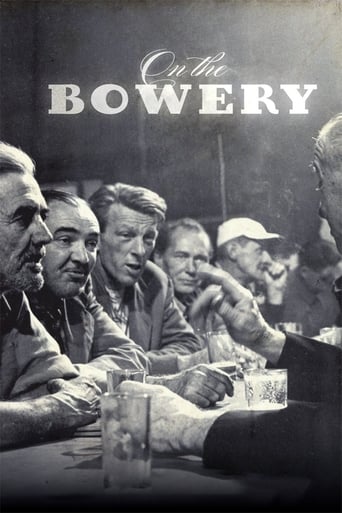
On the Bowery (1957)
A mix of documentary and scripted footage on the Bowery, New York City's skid row. Against a backdrop of men (and a few women) drinking in bars, talking and arguing, and sleeping on sidewalks, we have the story of Ray.
- Date of release
- 1957-03-18
- TMDB
- 6.7 / 10 (28)
- Runtime
- 1h 5m
- Genres
- Documentary, Drama
- Director
- Lionel Rogosin
Casting
- Ray Salyer — Self
- Gorman Hendricks — Self
- Frank Matthews — Self
- George L. Bolton — Self - Minister, Bowery Mission (uncredited)
Interesting facts
- Filmed in: New York City
- Awards: 0 · Nominations: 1
On the Bowery is a 1956 American docufiction film directed by Lionel Rogosin. The film, Rogosin's first feature was nominated for an Academy Award for Best Documentary Feature Film.
Production
After serving in the U.S. Navy during World War II, Rogosin worked first as a chemical engineer and earned enough to finance his first feature. He was influenced by Robert Flaherty and Vittorio De Sica as well as the 1930 film adaptation of All Quiet on the Western Front. His original plan was to make a film about apartheid in South Africa. With $30,000 in financing, he decided to focus on the Bowery as a practice project.
Rogosin got to know the street and the men intimately, befriending Ray Salyer as he was seeking day labor, and was delighted to find that his personal story was the one the filmmakers wanted to tell. He also met Gorman Hendricks, a longtime Bowery resident.
While researching the film he met Sufrin and cinematographer Dick Bagley, who was recently part of the crew of Sydney Myers' The Quiet One. Bagley was himself an alcoholic, and died five years later. Rogosin also obtained the cooperation of the Bowery Mission, where one sequence was filmed. Shooting took place over a three-month period, beginning in July 1955. Bagley hid his 35 millimeter Arriflex camera under a bundle to shoot some bar scenes.
When filming began, the Third Ave El had ceased running but had not yet been torn down, so the dark shadows the El cast on the Bowery were still present, adding to the dingy atmosphere. The actors for the film were taken off the street, and spoke in their own slang, only guided what to say. Direction was aimed at "defining the action but not gesture or inflection," Sufrin later said in an article in Sight and Sound.
The filmmakers encountered many difficulties when making the film. Cast members were arrested and returned to the street with shaves and haircuts, making it hard to match new material with what was filmed. Some simply disappeared. There was interference by police. Shooting at night without lights was difficult, and the El was in the process of being demolished as the film was being shot.
Read on Wikipedia · Text from Wikipedia, CC BY-SA 4.0. Data from Wikidata.
Recommended
- 42 Up 1999 · ★ 7.6
- Avatar: The Deep Dive - A Special Edition of 20/20 2022 · ★ 7.2
- McQueen 2018 · ★ 7.4
- My Mom Jayne 2025 · ★ 8.0
- Come See Me in the Good Light 2025 · ★ 7.1
- A Toxic Love Story 2026 · ★ 6.4
- Obi-Wan Kenobi: A Jedi's Return 2022 · ★ 6.8
- S4: The Bob Lazar Story 2026 · ★ 8.4
- Billie Eilish - Hit Me Hard and Soft: The Tour (Live in 3D) 2026 · ★ 8.4
- 35 Up 1991 · ★ 7.6
- Making The Witcher 2020 · ★ 7.1
- In the Realms of the Unreal 2004 · ★ 7.2