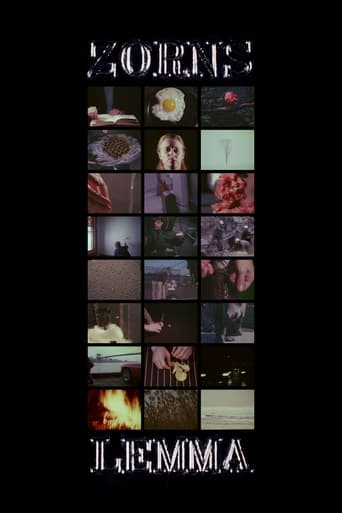
Zorns Lemma (1970)
Zorns Lemma is a 1970 American structural film by Hollis Frampton. It is named after Zorn's lemma (also known as the Kuratowski–Zorn lemma), a proposition of set theory formulated by mathematician Max Zorn in 1935. Zorns Lemma is prefaced with a reading from an early grammar textbook. The remainder of the film, largely silent, shows the viewer an evolving 24-part "alphabet" (where i & j and u & v are interchanged) which is cycled through, replaced and expanded upon. The film's conclusion shows a man, woman and dog walking through snow as several voices read passages from On Light, or the Ingression of Forms by Robert Grosseteste.
- Data lansării
- 1970-04-01
- TMDB
- 6.3 / 10 (33)
- Durată
- 1 h 0 min
- Genuri
- Documentar
- Regizor
- Hollis Frampton
Distribuție
Curiozități
Zorns Lemma is a 1970 American structural experimental film by Hollis Frampton. Originally starting as a series of photographs, the non-narrative film is structured around a 24-letter classical Latin alphabet. It remains, along with Michael Snow's Wavelength and Tony Conrad's The Flicker, one of the best known examples of structural filmmaking.
Production
Zorns Lemma emerged from Word Pictures, a photography project that Frampton made from 1962 to 1963. For Word Pictures, Frampton shot over 2000 black-and-white 35mm photographs of environmental words, seeking to explore the illusions of photography as a medium. However, he had difficulty devising a form in which to present the photographs.
Frampton thought that imposing his own order on the film would make it too similar to a poem, so he decided to use alphabetical order and avoid any conscious connections between words. Because the number of times he had captured each letter varied greatly, he decided to use the "double alphabet" and continuously cycle through the letters. This structure left "holes" to be filled in the film.
The final section of Zorns Lemma was shot in 1970. Frampton envisioned it as a time for the audience "to empty the mind". When loading and unloading the film rolls, he intentionally exposed them to sunlight and created reel-end flares to emphasize "the materiality of film".
Frampton's films are often titled after specialized scientific disciplines, as in the case of Maxwell's Demon, Prince Rupert's Drops, and Hapax Legomena. In the early 1960s minimalist artist Carl Andre described to Frampton the Dedekind cut, which partitions a totally ordered set into two subsets, one of whose elements are all less than those of the other, and can be used to construct the real numbers.
Citește pe Wikipedia · Text din Wikipedia, CC BY-SA 4.0. Date din Wikidata.
Recomandate
- Halloween: 25 Years of Terror 2006 · ★ 6.8
- Powaqqatsi 1988 · ★ 7.2
- Capital in the Twenty-First Century 2019 · ★ 6.5
- 180° South 2010 · ★ 7.2
- Hell and Back Again 2011 · ★ 6.3
- The U.S. vs. John Lennon 2006 · ★ 6.6
- More Brains! A Return to the Living Dead 2011 · ★ 7.4
- Justin Bieber's Believe 2013 · ★ 6.9
- Naqoyqatsi 2002 · ★ 6.2
- Cristiano Ronaldo: World at His Feet 2014 · ★ 7.6
- Burma VJ: Reporting from a Closed Country 2008 · ★ 7.3
- I Am Heath Ledger 2017 · ★ 7.4