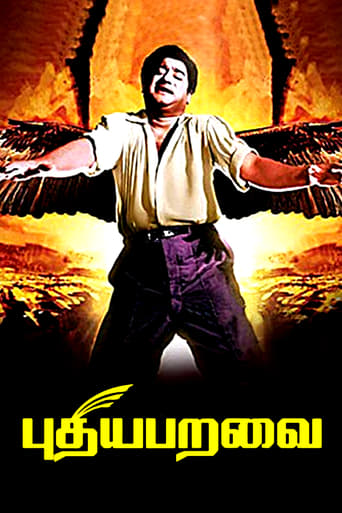
Puthiya Paravai (1964)
புதிய பறவை
Gopal, a rich widower, falls in love with Latha. As they are getting prepared to marry, Gopal's presumed-dead wife, Chitra arrives.
- Date of release
- 1964-09-12
- TMDB
- 7.0 / 10 (7)
- Runtime
- 2h 30m
- Genres
- Romance, Thriller
- Director
- Dada Mirasi
Casting
- Sivaji Ganesan — Gopal
- B. Saroja Devi — Latha
- M. R. Radha — Rangan
- Sowcar Janaki — Chitra/Saroja
- Nagesh — Sanjeev
- Manorama — Alli
- V. K. Ramasamy — Ramadurai
- O. A. K. Thevar — Kumar
- S. V. Ramadas — Raju
Interesting facts
- Filmed in: Ooty
Puthiya Paravai is a 1964 Indian Tamil-language romantic thriller film directed by Dada Mirasi. Produced by Sivaji Ganesan, the film stars himself, B. Saroja Devi, M. R. Radha and Sowcar Janaki, with Nagesh, Manorama, V. K. Ramasamy, O. A. K. Thevar and S. V. Ramadas in supporting roles. The plot revolves around Gopal, who falls in love with Latha, when his previously presumed-dead wife Chitra arrives. He claims her to be an impostor but no one believes him.
Production
The 1958 British thriller film Chase a Crooked Shadow, directed by Michael Anderson, was a global success, especially in India. It inspired the Bengali film Sesh Anka (1963) whose screenplay was written by Rajkumar Mitra. The screenplay was acquired by Sivaji Ganesan's company Sivaji Films (later renamed Sivaji Productions) to be remade in Tamil.
While Sivaji Ganesan played the male lead Gopal, B. Saroja Devi was cast as Gopal's love interest Latha at Shanmugham's suggestion. According to Ganesan's eldest son Ramkumar, Ganesan "always thought of Sowcar Janaki as classy and sophisticated," which was why he cast her as a "modern woman" in Puthiya Paravai. "Before that Sowcar had only acted in homely roles".
Mirasi, who made a cameo appearance as Gopal's father, initially objected to Ganesan's desire to cast Janaki because he felt the actress, then known mainly for sentimental roles, would not fit the stylish character of Chitra. But Ganesan remained adamant as he felt Janaki was perfect as Chitra and was supported by Aaroor Dass, so Mirasi half-heartedly agreed.
Principal photography for Puthiya Paravai took place at Neptune Studios and Vijaya Vauhini Studios, though filming also took place at Ooty. It was filmed in Eastmancolor. The majority of costumes were tailored and brought from Singapore and England. On the first day of shooting, Janaki did not like the dress tailored for her, and instead opted for a black sari she bought in Hong Kong a few months earlier.
After the climax was finished, Aaroor Doss immediately requested Ganesan and Mirasi to do the sequence again with the addition of the dialogue "Pennmaye! Nee Vaazhga! Ullame Unakku Oru Nanri" (transl. Oh lady! May you live long! A note of thanks to your heart).
Read on Wikipedia · Text from Wikipedia, CC BY-SA 4.0. Data from Wikidata.
Recommended
- Safe Haven 2013 · ★ 7.2
- Attraction 2001 · ★ 6.9
- Chief of Station 2024 · ★ 6.3
- The 355 2022 · ★ 6.0
- X 2011 · ★ 6.4
- Bad Sister 2015 · ★ 6.6
- Off the Grid 2025 · ★ 6.4
- Hunting Grounds 2025 · ★ 7.0
- Dangerous 2021 · ★ 6.0
- Stowaway 2022 · ★ 6.0
- Point Blank 2019 · ★ 6.0
- The Best Man 2023 · ★ 6.0