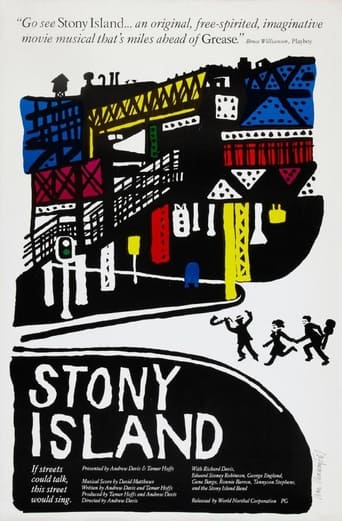
Stony Island (1978)
If streets could talk, this street would sing.
Richie Bloom, the only white kid on the block, forms an R&B band with his best friend, Kevin. With the help of their mentor, aging sax legend Percy, they pull together a funky supergroup. Despite few resources and heavy losses this resilient group of dedicated musicians, armed only with wit, sleight of hand and outrageous Chicago bravado must come together to finally make their smash debut.
- Date of release
- 1978-11-17
- TMDB
- 8.0 / 10 (4)
- Runtime
- 1h 37m
- Genres
- Music, Drama
- Director
- Andrew Davis
Casting
- Richard Davis — Richie Bloom
- Edward Stoney Robinson — Kevin Tucker
- George Englund Jr — Harold Tate
- Gene Barge — Percy Price
- Ronnie Barron — Ronnie Roosevelt
- Tennyson Stephens — Tennyson
- Larry Ball — Larry
- Windy Barnes — Windy
- Rae Dawn Chong — Janetta
- Donnell Hagen — Donnell
- Criss Johnson — Criss
- Kenneth Brass — Kenny
Interesting facts
Stony Island is a 1978 American musical drama film directed by Andrew Davis, and written by Davis and Tamar Simon Hoffs. The movie stars Richard Davis, the director's brother, and Edward "Stoney" Robinson. The co-stars include Dennis Franz, Rae Dawn Chong, Gene Barge, and Susanna Hoffs.
Production and release
During the mid-1970s, Davis was a rising cinematographer; according to him, during this time he was hired to work on important films, but also chose to work on low-budget films because he "wanted to see what it was like to make a movie for very little money. This allowed me to later say ‘let’s try to make Stony Island’."
Director Davis explained that the inspiration for"Stony Island was a story about my brother growing up in the south side of Chicago. I also grew up there, but it was really about his journey in a neighborhood that was changing. My parents had stayed in this neighborhood, and my brother was putting together a band with some other kids."
Davis co-wrote the film with Tamar Simon Hoffs, and the cast includes Davis's brother Richard Davis, Gene Barge, Rae Dawn Chong, Susanna Hoffs, Dennis Franz, and Oscar Brown Jr.
The budget for the film was under $380,000, and when it was finalized Twentieth Century-Fox screened it. They turned it down, thinking "it was too arty for kids and too black for suburban art-houses". This led World Northal to choose it for distribution and placed it in art-houses and urban cinemas that summer. Davis recovered two-thirds of the budget and started to be sought after by film studios for urban films.
Read on Wikipedia · Text from Wikipedia, CC BY-SA 4.0. Data from Wikidata.
Recommended
- Clika 2026 · ★ 8.3
- Coda 2020 · ★ 6.1
- Battle of the Year 2013 · ★ 6.8
- Honey: Rise Up and Dance 2018 · ★ 6.9
- Teen Spirit 2019 · ★ 6.0
- Good Vibrations 2012 · ★ 6.7
- You Got Served 2004 · ★ 6.4
- Grace Unplugged 2013 · ★ 6.0
- Honeydripper 2007 · ★ 5.9
- Mo' Better Blues 1990 · ★ 6.5
- Hounddog 2008 · ★ 6.5
- Jailhouse Rock 1957 · ★ 6.3