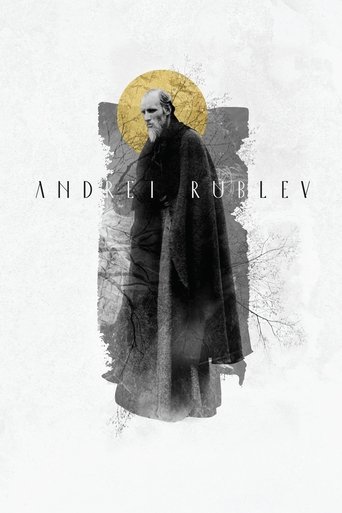
Andrei Rublev (1966)
Андрей Рублёв
In much wisdom there is much grief.
An expansive Russian drama, this film focuses on the life of revered religious icon painter Andrei Rublev. Drifting from place to place in a tumultuous era, the peace-seeking monk eventually gains a reputation for his art. But after Rublev witnesses a brutal battle and unintentionally becomes involved, he takes a vow of silence and spends time away from his work. As he begins to ease his troubled soul, he takes steps towards becoming a painter once again.
- Date of release
- 1966-12-16
- TMDB
- 7.9 / 10 (993)
- Runtime
- 3h 3m
- Genres
- Drama, History
- Director
- Andrei Tarkovsky
Casting
- Anatoliy Solonitsyn — Andrei Rublev
- Ivan Lapikov — Kirill
- Mykola Hrynko — Daniil Chornyy
- Nikolai Sergeyev — Theophanus the Greek
- Irma Raush — God's Fool
- Nikolay Burlyaev — Boriska
- Yuriy Nazarov — Grand Duke / Minor Duke
- Yuriy Nikulin — Patrikey
- Rolan Bykov — Buffoon
- Nikolay Grabbe — Stepan, Centurion of the Grand Duke
- Mikhail Kononov — Foma
- Stepan Krylov — Senior Foundry Worker
Interesting facts
- Budget: RUB 900K
- Filmed in: Moscow and Russia
Andrei Rublev is a 1966 Soviet epic biographical historical drama film directed by Andrei Tarkovsky who co-wrote it with Andrei Konchalovsky. The film was re-edited from the 1966 film titled The Passion According to Andrei by Tarkovsky which was censored during the first decade of the Brezhnev era in the Soviet Union. The film is loosely based on the life of Andrei Rublev, a 15th-century Russian icon painter. The film features Anatoly Solonitsyn, Nikolai Grinko, Ivan Lapikov, Nikolai Sergeyev, Nikolai Burlyayev and Tarkovsky's wife Irma Raush. Savva Yamshchikov, a famous Russian restorer and art historian, was a scientific consultant for the film.
Production
In 1961, while working on his first feature film Ivan's Childhood, Tarkovsky made a proposal to Mosfilm for a film on the life of Russia's greatest icon painter, Andrei Rublev. The contract was signed in 1962 and the first treatment was approved in December 1963. Tarkovsky and his co-screenwriter Andrei Konchalovsky worked for more than two years on the script, studying medieval writings and chronicles and books on medieval history and art.
According to Tarkovsky, the original idea for a film about the life of Andrei Rublev was due to the film actor Vasily Livanov. Livanov proposed to write a screenplay together with Tarkovsky and Konchalovsky while they were strolling through a forest on the outskirts of Moscow. He also mentioned that he would love to play Andrei Rublev. Tarkovsky did not intend the film to be a historical or a biographical film about Andrei Rublev.
Tarkovsky cast Anatoly Solonitsyn for the role of Andrei Rublev. At this time Solonitsyn was an unknown actor at a theatre in Sverdlovsk. According to Tarkovsky everybody had a different image of the historical figure of Andrei Rublev, thus casting an unknown actor who would not remind viewers of other roles was his favoured approach.
According to Johnson, filming did not begin until April 1965, one year after approval of the script, with J. Hoberman reporting an earlier date of September 1964 for the start of filming in his film essay for the Criterion collection release of the film. The initial budget was 1.6 million Rbls, but it was cut several times to one million roubles (In comparison, Sergei Bondarchuk's War and Peace had a budget of eight and half million roubles).
Tarkovsky chose to shoot the main film in black and white and the epilogue, showing some of Rublev's icons, in colour. In an interview he motivated his choice with the claim that in everyday life one does not consciously notice colours. Consequently, Rublev's life is in black and white, whereas his art is in colour. The film was thus able to express the co-dependence of an artist's art and his personal life.
Read on Wikipedia · Text from Wikipedia, CC BY-SA 4.0. Data from Wikidata.
Recommended
- Tsar 2009 · ★ 6.0
- William Tell 2025 · ★ 6.2
- Flesh + Blood 1985 · ★ 6.6
- The Last Duel 2021 · ★ 7.4
- The Last Temptation of Christ 1988 · ★ 7.2
- The Passion of the Christ 2004 · ★ 7.5
- The Name of the Rose 1986 · ★ 7.5
- Shooting Dogs 2006 · ★ 7.5
- The Physician 2013 · ★ 7.3
- Waiting for the Barbarians 2020 · ★ 5.9
- King of Kings 1961 · ★ 7.2
- Titus 1999 · ★ 6.4