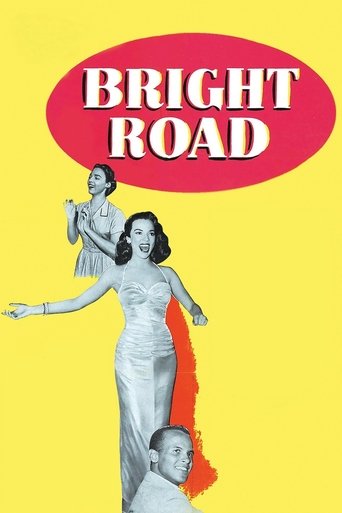
Bright Road (1953)
THE AWARD STORY from The Ladies' Home Journal has become the most unusual picture of the year.
Teachers at an all-black school fight to save a problem child.
- Date of release
- 1953-04-17
- TMDB
- 6.5 / 10 (10)
- Runtime
- 1h 8m
- Genres
- Drama, Music
- Director
- Gerald Mayer
Casting
- Dorothy Dandridge — Jane Richards
- Philip Hepburn — C.T. Young
- Harry Belafonte — Mr. Williams - School Principal
- Barbara Randolph — Tanya Hamilton
- Robert Horton — Dr. Mitchell
- Maidie Norman — Mrs. Hamilton - Tanya's Mother
- Rene Beard — Booker T. Jones
- Howard Louis McNeely — Boyd
- Robert McNeeley — Lloyd
- Patti Marie Ellis — Rachel Smith
- Fred Moultrie — Roger
- James Moultrie — George
Interesting facts
Bright Road is a 1953 low-budget film adapted from the Christopher Award-winning short story "See How They Run" by Mary Elizabeth Vroman. Directed by Gerald Mayer and featuring a nearly all-black cast, the film stars Dorothy Dandridge as an idealistic first-year elementary school teacher trying to communicate with a problem student. The film is also notable as the first appearance by Harry Belafonte, who costars as the principal of the school.
Production
Bright Road was produced at MGM by Sol Baer Fielding.
"See How They Run" was Mary Elizabeth Vroman's first published short story, written while she was a schoolteacher in rural Alabama. First published in Ladies' Home Journal in 1951, it also appeared in Ebony magazine in 1952. When Metro-Goldwyn-Mayer purchased the rights to adapt the story to film, Vroman helped write the screenplay, and as a result, became the first black member of the Screen Writers Guild.
Belafonte and Dandridge were known to audiences for their singing talents, which are showcased in Bright Road. Early in the film, Belafonte sings "Suzanne (Every Night When the Sun Goes Down)", and later, Dandridge briefly sings words from the Alfred Tennyson poem "The Princess: Sweet and Low" to the tune of a lullaby. Belafonte and Dandridge costarred again in the musical film Carmen Jones (1954).
Dandridge had been attracted to the lack of racial conflict in the story. She wrote that she was "profoundly fond of ... a theme which showed that beneath any color skin, people were simply people. I had a feeling that themes like this might do more real good than the more hard-hitting protest pictures.
Read on Wikipedia · Text from Wikipedia, CC BY-SA 4.0. Data from Wikidata.
Recommended
- Honeydripper 2007 · ★ 5.9
- Won't Back Down 2012 · ★ 6.2
- Glory Road 2006 · ★ 7.4
- Music of the Heart 1999 · ★ 6.7
- To Kill a Mockingbird 1962 · ★ 8.0
- The Christmas Shoes 2002 · ★ 6.8
- The River 1984 · ★ 6.4
- Too Late Blues 1961 · ★ 6.4
- WWE Day 1 2022 2022 · ★ 7.2
- Take the Lead 2006 · ★ 6.9
- Wonder 2017 · ★ 8.1
- All Together Now 2020 · ★ 6.7