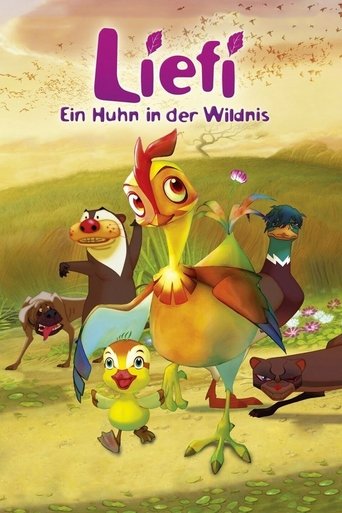
Liefi - Ein Huhn in der Wildnis (2011)
마당을 나온 암탉
Die Henne Liefi lebt in einer Legebatterie und will nichts wie weg, einmal die Sonne sehen und auf richtigem Boden stehen. Durch eine List - sie stellt sich tot - gelingt es ihr. Doch kaum rappelt sie sich in einem Waldstück hoch, wo sie mitsamt den toten Artgenossen entsorgt wurde, wird sie von einem Wiesel angegriffen. Sie bekommt unerwartet Hilfe. Ihr Traum, ein Ei auszubrüten, geht in Erfüllung, ist es auch nur die Brut einer vom Wiesel geschnappten Wildente. Sie zieht den Jungen auf wie ihr eigenes Küken.
- Erscheinungsdatum
- 2011-07-28
- TMDB
- 7.8 / 10 (147)
- Laufzeit
- 1 Std. 31 Min.
- Genres
- Animation, Familie, Abenteuer, Drama
- Regie
- Oh Sung-yoon
Besetzung
- Moon So-ri — Leafie (voice)
- 유승호 — Greenie (voice)
- Choi Min-sik — Wanderer (voice)
- 박철민 — Mayor (voice)
- 김상현 — One-Eye (voice)
- 전숙경 — Jjaek (voice)
- 엄상현 — Rooster (voice)
- 사성웅 — Red Head (voice)
- Kim Ji-hye — Wanderer's Mate / Yard Hen (voice)
- 서승원 — Owl / Duck Captain (voice)
- 한신정 — Young Greenie / Barnyard Duck (voice)
- 홍범기 — Bat / Kanjugi (voice)
Wissenswertes
- Basiert auf: A Hen into the Wild
Leafie, A Hen into the Wild, also called Daisy, A Hen into the Wild in English-speaking countries, is a 2011 South Korean animated adventure film based on the book of the same name. It depicts the freedom, will and instinctive motherly love of a hen as she raises an adopted duckling. The film made box office history by drawing over 2.2 million viewers, the largest audience for a home-grown animated film in South Korea. It also received widespread critical acclaim upon release.
Production
Director Oh Sung-yoon struggled for more than twenty years as an animator under adverse economic circumstances before finally debuting with this feature film. Originally titled YIPSAK - A Chicken Wild, the movie took Myung Films six years (three years for pre-production including scriptwriting, and one and a half year for storyboard) and ₩3 billion (US$2.8 million) to produce.
Shim Jae-myung (also known as Jaime Shim), the head of Myung Films, which co-produced Leafie in conjunction with the local animation studio Odolttogi, said that it was her experience with major motion pictures that made her want to produce animated films that could compete with those from Hollywood and Japan. "And as a woman and mother, the plot touched my heart," she said.
When asked what they did to distinguish their film from films by the world's major studios, director Oh said he and the crew focused on making the visual effects as beautiful as possible. "Most of my staff and I majored in painting, and we chose to make the film two-dimensional, so that the entire product looks like a beautiful picture," Oh said.
Auf Wikipedia weiterlesen · Text aus Wikipedia, CC BY-SA 4.0. Daten aus Wikidata.
Empfohlen
- TinkerBell - Die Suche nach dem verlorenen Schatz 2009 · ★ 6.8
- Die Olchis - Willkommen in Schmuddelfing 2021 · ★ 6.7
- Der Junge, der Maulwurf, der Fuchs und das Pferd 2022 · ★ 8.2
- Das Dschungelbuch 1967 · ★ 7.3
- Paw Patrol - Die große Rettungsaktion 2019 · ★ 7.1
- 100% Wolf 2020 · ★ 6.1
- Nocturna 2007 · ★ 7.1
- Coco auf wilder Verfolgungsjagd 2009 · ★ 6.5
- Kubo - Der tapfere Samurai 2016 · ★ 7.7
- Paw Patrol - Die Düsenrettung 2020 · ★ 7.1
- Khumba - Das Zebra ohne Streifen am Popo 2013 · ★ 6.0
- Coco, der neugierige Affe 3 - Zurück in den Dschungel 2015 · ★ 6.7