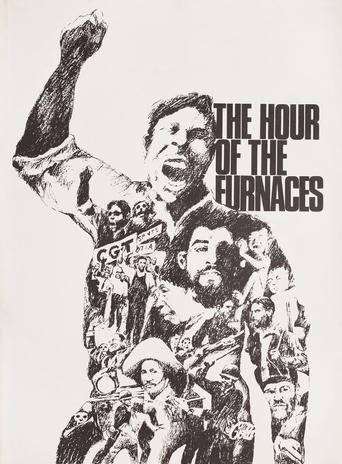
The Hour of the Furnaces (1968)
La hora de los hornos
An impassioned three-part documentary of the liberation struggle waged throughout Latin America, using Argentina as a historical example of the imperialist exploitation of the continent. Part I: Neo-Colonialism and Violence is a historical, geographic, and economic analysis of Argentina. Part II: An Act For Liberation examines the ten-year reign of Juan Perón (1945-55) and the activities of the Peronist movement after his fall from power. Part III: Violence and Liberation studies the role of violence in the national liberation process and constitutes a call for action.
- Date of release
- 1968-09-30
- TMDB
- 6.9 / 10 (33)
- Runtime
- 4h 20m
- Genres
- Documentary
- Director
- Octavio Getino, Fernando E. Solanas
Casting
- María de la Paz — Narrator
- Fernando E. Solanas — Narrator
- Edgardo Suárez — Narrator
- Juan Domingo Perón — Self (archive footage)
- Che Guevara — Self (archive footage)
- Fidel Castro — Self (archive footage)
Interesting facts
The Hour of the Furnaces is a 1968 Argentine political documentary film directed by Octavio Getino and Fernando Solanas. 'The paradigm of revolutionary activist cinema', it addresses the politics of the 'Third worldist' films and Latin-American manifesto of the late 1960s. It is a key part of the 'Third Cinema', a movement that emerged in Latin America around the same time as the film's release. The work is a four-hour trilogy, divided into chapters and united by the theme of dependency and liberation. The first part - "Neo-Colonialism and Violence" - is conceived for diffusion in all types of circuits, and is the one presented at Cannes Classics.
Production and distribution
The production of The Hour of the Furnaces lasted from 1966 to 1968 and utilized techniques that have since then been described as "guerilla style filmmaking," and a documentary-like style to convey its message. The team behind The Hour of the Furnaces recorded citizens of Argentina as they went about their daily lives, supplementing their work with archival footage and works by other filmmakers.
Due to political considerations of the time, The Hour of the Furnaces saw an incredibly limited release in Argentina and was primarily shown in underground clubs and organizations. The film was segmented into several parts with the intention that viewers would take the time to discuss each individual section after it was completed.
Read on Wikipedia · Text from Wikipedia, CC BY-SA 4.0. Data from Wikidata.
Recommended
- Come See Me in the Good Light 2025 · ★ 7.0
- Fuck 2006 · ★ 6.4
- South of the Border 2009 · ★ 6.1
- S4: The Bob Lazar Story 2026 · ★ 8.4
- As I Was Moving Ahead Occasionally I Saw Brief Glimpses of Beauty 2000 · ★ 7.8
- Looking for Richard 1996 · ★ 6.8
- The Curse of the Dragon 1993 · ★ 7.2
- Anna Nicole Smith: You Don't Know Me 2023 · ★ 6.1
- Zeitgeist: Moving Forward 2011 · ★ 7.0
- Downloaded 2013 · ★ 6.5
- My Mom Jayne 2025 · ★ 8.0
- Mea Maxima Culpa: Silence in the House of God 2012 · ★ 7.3