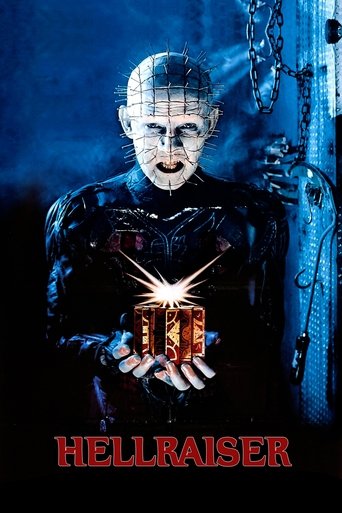
Hellraiser (1987)
Demon to some. Angel to others.
A hedonistic man finds a mysterious puzzle box that summons a group of gruesome beings known as the Cenobites. These otherworldly entities open the doors to a dominion where pain and pleasure are indivisible.
- Date of release
- 1987-09-11
- TMDB
- 6.9 / 10 (3097)
- Runtime
- 1h 33m
- Genres
- Horror, Thriller
- Director
- Clive Barker
- Collection
- Hellraiser Collection
Casting
- Andrew Robinson — Larry
- Clare Higgins — Julia
- Ashley Laurence — Kirsty
- Oliver Smith — Frank the Monster
- Sean Chapman — Frank
- Robert Hines — Steve
- Doug Bradley — Lead Cenobite
- Nicholas Vince — Chattering Cenobite
- Simon Bamford — 'Butterball' Cenobite
- Grace Kirby — Female Cenobite
- Anthony Allen — 1st Victim
- Leon Davis — 2nd Victim
Interesting facts
- Box office: $14.6M
- Budget: $1M
- Earned 14.6× its budget
- Based on: The Hellbound Heart
- Filmed in: Pinewood Studios
Hellraiser is a 1987 British supernatural horror film written and directed by Clive Barker in his directorial debut. Based on his own 1986 novella The Hellbound Heart, the film's plot concerns a mystical puzzle box that summons the Cenobites, a group of extra-dimensional, sadomasochistic beings who cannot differentiate between pain and pleasure. It stars Andrew Robinson, Clare Higgins, Ashley Laurence, and Doug Bradley as the leader of the Cenobites.
Production
Having been dismayed at prior cinematic adaptations of his work, Barker, who had experience from writing, directing and starring in plays and had made two short films, decided to attempt to direct a film himself. He asked Christopher Figg, who became his producer, how small the budget would have to be for someone being willing to hire him as a first time director.
Hellraiser was filmed at the end of 1986 and was set to be made in seven weeks, but was extended over a nine- to ten-week period by New World. The film was originally made under the working title of Sadomasochists from Beyond the Grave. Barker also wanted to call the film Hellbound but producer Christopher Figg suggested Hellraiser instead.
During production, Doug Bradley had trouble hitting his marks during his takes in make-up as he could not see through his black contact lenses and was afraid of tripping over Pinhead's skirts. The special effects of the unnamed creature, known as "The Engineer" in the novels, proved challenging as the creature was difficult to maneuver.
About seven or eight weeks after principal photography had finished, the executive producers saw the footage and liked the film enough to invest more into it. Because of this, a few scenes were redone with a higher budget, like the scene near the end where Frank's body is ripped apart. To produce Frank's resurrection, effects like reverse motion were used to give his skeleton flesh and inner organs.
The film had two editors: Richard Marden and an uncredited Tony Randel.
Read on Wikipedia · Text from Wikipedia, CC BY-SA 4.0. Data from Wikidata.
Recommended
- Hellbound: Hellraiser II 1988 · ★ 6.4
- Hellraiser 2022 · ★ 6.2
- And Now the Screaming Starts! 1973 · ★ 5.9
- Nightmare Cinema 2018 · ★ 5.8
- Books of Blood 2020 · ★ 6.2
- The Exorcist 1973 · ★ 7.8
- Jigsaw 2017 · ★ 6.2
- Play Dead 2025 · ★ 6.3
- Ghostland 2018 · ★ 7.4
- Maniac 2012 · ★ 6.0
- Infinity Pool 2023 · ★ 6.0
- Haunt 2019 · ★ 6.7