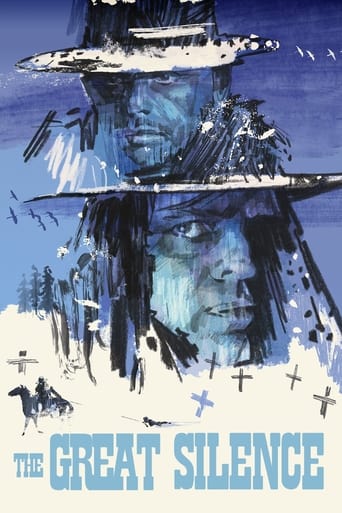
The Great Silence (1968)
Il grande silenzio
His voice was the silence of death!
A mute gunslinger fights in the defense of a group of outlaws and a vengeful young widow, against a group of ruthless bounty hunters.
- Date of release
- 1968-11-22
- TMDB
- 7.5 / 10 (495)
- Runtime
- 1h 47m
- Genres
- Western, Drama
- Director
- Sergio Corbucci
Casting
- Jean-Louis Trintignant — Silence
- Klaus Kinski — Tigrero
- Frank Wolff — Sheriff Gideon Corbett
- Luigi Pistilli — Henry Pollicut
- Mario Brega — Martin
- Carlo D'Angelo — Utah Governor
- Marisa Merlini — Regina
- Maria Mizar — Blonde Saloon Girl
- Marisa Sally — Black-Haired Saloon Girl
- Raf Baldassarre — Bobo Schultz
- Spartaco Conversi — Walter
- Remo De Angelis — Sheriff in Flashback
Interesting facts
The Great Silence is a 1968 spaghetti Western film directed and co-written by Sergio Corbucci. An Italian-French co-production, the film stars Jean-Louis Trintignant, Klaus Kinski, Vonetta McGee and Frank Wolff, with Luigi Pistilli, Mario Brega, Marisa Merlini and Carlo D'Angelo in supporting roles.
Production
By 1967, Sergio Corbucci had grown weary of making Westerns that varied widely in quality and commercial viability. Having returned to Rome after completing principal photography on the Eurospy film Death on the Run in Athens, he decided that another Western, set during a blizzard — reportedly an homage to two other "snow Westerns", André de Toth's Day of the Outlaw and John Ford's Cheyenne Autumn — would provide a similar change of pace.
Casting English-speaking lead actors in Spaghetti Westerns was a growing practice because it was believed to allow international marketability. Marcello Mastroianni had conceived the idea of a mute gunfighter when he told Corbucci that he had always wanted to appear in a Western, but would have been held back by his inability to speak English.
Corbucci hired established German actor Klaus Kinski to play Loco, a character who was partially intended to emulate Gorca, the vampire played by Boris Karloff in Mario Bava's Black Sabbath, which served as a major stylistic influence on The Great Silence.
Location filming began in late 1967 in Cortina d'Ampezzo (Veneto) and San Cassiano in Badia (South Tyrol). Several Snow Hill scenes were shot on a set specifically built for the film, with log cabins and alpine roofs. Many of the surrounding hills were used for various set-pieces, including Loco's gang's hideout, the way station, the stagecoach route and the Snow Hill graveyard.
Most of the Snow Hill scenes filmed at Elios were shot at night so that the fake "snow" looked more convincing; 26 tons of shaving cream was used to give the street a snowbound look. For the daylight scenes, the Elios set was swathed in fog, to disguise the fact that the surrounding countryside had no snow. Camera overexposure was also occasionally used to avoid continuity errors.
Read on Wikipedia · Text from Wikipedia, CC BY-SA 4.0. Data from Wikidata.
Recommended
- Day of the Outlaw 1959 · ★ 6.8
- The Magnificent Seven 1960 · ★ 7.5
- Rust 2024 · ★ 6.8
- Silverado 1985 · ★ 6.9
- The Man Who Shot Liberty Valance 1962 · ★ 7.8
- The Naked Spur 1953 · ★ 7.0
- Badland 2019 · ★ 6.3
- Dances with Wolves 1990 · ★ 7.8
- Boss Nigger 1975 · ★ 6.7
- The Shootist 1976 · ★ 7.1
- The Shooting 1966 · ★ 6.3
- The White Buffalo 1977 · ★ 6.0