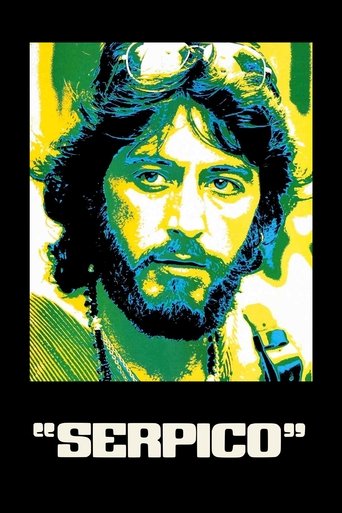
Serpico (1973)
Many of his fellow officers considered him the most dangerous man alive - an honest cop.
New York cop Frank Serpico blows the whistle on the rampant corruption in the force only to have his comrades turn against him.
- Date of release
- 1973-12-18
- TMDB
- 7.5 / 10 (2341)
- Runtime
- 2h 9m
- Genres
- Crime, Drama
- Director
- Sidney Lumet
Casting
- Al Pacino — Officer Frank Serpico
- John Randolph — Sidney Green
- Jack Kehoe — Tom Keough
- Biff McGuire — Captain McClain
- Barbara Eda-Young — Laurie
- Cornelia Sharpe — Leslie Lane
- Tony Roberts — Bob Blair
- John Medici — Pasquale
- Allan Rich — D. A. Tauber
- Norman Ornellas — Rubello
- Edward Grover — Lombardo
- Albert Henderson — Peluce
Interesting facts
- Box office: $29.9M
- Budget: $3.3M
- Earned 9× its budget
- Filmed in: New York City
- Awards: 1 · Nominations: 2. Including: National Board of Review: Top Ten Films
Serpico is a 1973 American biographical crime drama film directed by Sidney Lumet and starring Al Pacino in the title role, former New York City police officer Frank Serpico. The screenplay was adapted by Waldo Salt and Norman Wexler from the book written by Peter Maas, with the assistance of its subject. The story details Serpico's struggle with corruption within the New York City Police Department during his eleven years of service, and his work as a whistleblower which led to the investigation by the Knapp Commission.
Production
Sidney Lumet organized the 107 speaking parts that took place in 104 different locations. The longest scenes took up two-and-a-half pages of the screenplay, while the average was one page.
A budget of $3.3 million (equivalent to $23.9 million in 2025) was assigned. Two weeks of rehearsals were held. Pacino had learned Salt's screenplay, and he agreed with Lumet that Wexler's revised version improved the structure, but that the dialogue was impoverished. Lumet allowed the actors to improvise certain dialogues, and he also allowed their creative input for the scenes.
The principal photography on Serpico began in early July 1973. The film was planned to be released before Christmas, with four-and-a-half months for the crew to complete the movie. Filming took place in July and August. The story of the film encompassed 11 years, from 1960 through 1971.
To accommodate the scenes around Pacino's facial hair, the film was shot in reverse. Pacino started with long beard and hair. He was shaved to a mustache, and eventually, his hair was cut and he was clean-shaven for the beginning of the film. Lumet decided each day if Pacino was to be further shaven, and the crew prepared fake beards in case they were required. Winter conditions were simulated, as the team had to defoliate trees and cut shrubs.
The director followed Serpico's desire for the winter to look "cold and heavy", and the summer "idyllic and hazy". The team had difficulty to find locations suitable for the scenes set in the 1960s, since graffiti did not become common until 1970. Lumet shot up to 35 different setups daily. The team had to move three times a day on average.
Read on Wikipedia · Text from Wikipedia, CC BY-SA 4.0. Data from Wikidata.
Recommended
- Q & A 1990 · ★ 5.9
- Cop Land 1997 · ★ 6.8
- American Gangster 2007 · ★ 7.6
- Dark Blue 2002 · ★ 6.2
- Out for Justice 1991 · ★ 6.2
- Rebel Ridge 2024 · ★ 7.0
- Night Falls on Manhattan 1997 · ★ 6.3
- The Alto Knights 2025 · ★ 6.2
- Havoc 2025 · ★ 6.4
- The Mob 1951 · ★ 6.7
- Donnie Brasco 1997 · ★ 7.5
- Magnum Force 1973 · ★ 7.1