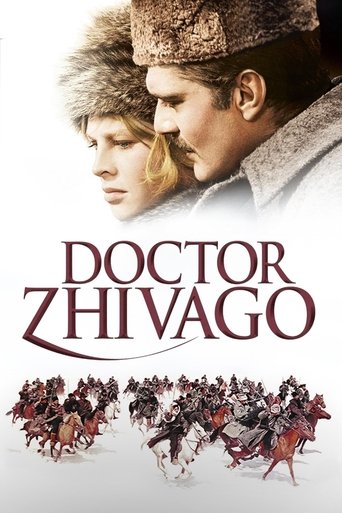
Doctor Zhivago (1965)
A Love Caught in the Fire of Revolution
The life of a Russian physician and poet who, although married to another, falls in love with a political activist's wife and experiences hardship during World War I and then the October Revolution.
- Date of release
- 1965-12-22
- TMDB
- 7.6 / 10 (1335)
- Runtime
- 3h 20m
- Genres
- Drama, Romance, War
- Director
- David Lean
Casting
- Omar Sharif — Dr. Yuri Zhivago
- Julie Christie — Lara Antipova
- Geraldine Chaplin — Tonya Gromeko
- Rod Steiger — Viktor Komarovsky
- Alec Guinness — Gen. Yevgraf Zhivago
- Tom Courtenay — Pasha Antipov / Strelnikov
- Siobhán McKenna — Anna
- Ralph Richardson — Alexander Gromeko
- Rita Tushingham — The Girl
- Adrienne Corri — Amelia
- Bernard Kay — The Bolshevik
- Geoffrey Keen — Medical Professor
Interesting facts
- Box office: $111.7M
- Budget: $15M
- Earned 7.4× its budget
- Based on: Doctor Zhivago
- Filmed in: Madrid, Spain, Finland, Helsinki, Heinävaara, Barajas and 3 more
- Awards: 15 · Nominations: 10. Including: Academy Award for Best Production Design; Academy Award for Best Writing, Adapted Screenplay; Academy Award for Best Costume Design; Academy Award for Best Original Score
Doctor Zhivago is a 1965 epic historical romance film directed by David Lean with a screenplay by Robert Bolt, based on the 1957 novel by Boris Pasternak. The story is set in Russia during World War I and the Russian Civil War. The film stars Omar Sharif in the title role as Yuri Zhivago, a married physician and poet whose life is altered by the Russian Revolution and subsequent civil war, and Julie Christie as his lover Lara Antipova. Geraldine Chaplin, Tom Courtenay, Rod Steiger, Alec Guinness, Ralph Richardson, Siobhán McKenna, and Rita Tushingham play supporting roles.
Production
Boris Pasternak's novel was published in the West amidst celebration and controversy. Pasternak began writing it in 1945, and was giving private readings of excerpts as early as 1946. However, the novel was not completed until 1956. The book had to be smuggled out of the Soviet Union by an Italian called D'Angelo to be delivered to Giangiacomo Feltrinelli, a left-wing Italian publisher who published it shortly thereafter, in 1957.
Pasternak was awarded the 1958 Nobel Prize for Literature. While the citation noted his poetry, it was speculated that the prize was mainly for Doctor Zhivago, which the Soviet government saw as an anti-Soviet work, thus interpreting the award of the Nobel Prize as a gesture hostile to the Soviet Union. A target of the Soviet government's fervent campaign to label him a traitor, Pasternak felt compelled to refuse the Prize.
The film treatment by David Lean was proposed for various reasons. Pasternak's novel had been an international success, and producer Carlo Ponti was interested in adapting it as a vehicle for his wife, Sophia Loren. Lean, coming off the huge success of Lawrence of Arabia (1962), wanted to make a more intimate, romantic film to balance the action- and adventure-oriented tone of his previous film.
Sharif was quite surprised when Lean suggested that he play Zhivago. Peter O'Toole, star of Lawrence of Arabia, was Lean's original choice for Zhivago, but turned the part down; Max von Sydow and Paul Newman were also considered. Rod Taylor was offered the role but turned it down.
Lean convinced Ponti that Loren was not right for the role of Lara, saying she was "too tall" (and confiding in screenwriter Robert Bolt that he could not accept Loren as a virgin for the early parts of the film), and Jeanne Moreau, Yvette Mimieux, Sarah Miles and Jane Fonda were considered for the role.
Read on Wikipedia · Text from Wikipedia, CC BY-SA 4.0. Data from Wikidata.
Recommended
- A Farewell to Arms 1957 · ★ 6.0
- Reds 1981 · ★ 6.9
- Anna Karenina 1997 · ★ 6.1
- Hell's Angels 1930 · ★ 6.6
- The History of Love 2016 · ★ 6.4
- Private Peaceful 2012 · ★ 6.6
- Wings 1927 · ★ 7.2
- Suite Française 2015 · ★ 7.2
- Women in Love 1969 · ★ 6.6
- Benediction 2021 · ★ 6.1
- Never Let Me Go 2010 · ★ 6.8
- It Ends with Us 2024 · ★ 6.9