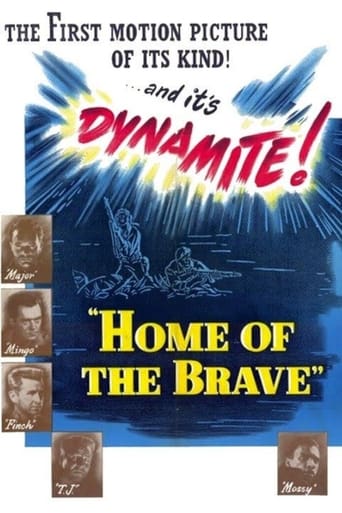
Home of the Brave (1949)
Die Probleme eines sensiblen, gebildeten Schwarzen während des Zweiten Weltkriegs. Im Grunde sind sie identisch mit den Problemen, die er bereits in Friedenszeiten hatte – ein Umstand, der durch Rückblenden auf sein Leben und vor allem auf seine Erlebnisse im Krieg verdeutlicht wird
- Erscheinungsdatum
- 1949-05-12
- TMDB
- 6.7 / 10 (19)
- Laufzeit
- 1 Std. 26 Min.
- Genres
- Drama, Kriegsfilm
- Regie
- Mark Robson
Besetzung
- Jeff Corey — Doctor
- James Edwards — Private Peter Moss
- Lloyd Bridges — Finch
- Douglas Dick — Major Robinson
- Frank Lovejoy — Sergeant Mingo
- Steve Brodie — T.J. Everett
- Cliff Clark — Colonel Baker
Wissenswertes
- Basiert auf: Home of the Brave
- Auszeichnungen: 1 · Nominierungen: 0. Darunter: National Board of Review/Top Ten Filme
Home of the Brave is a 1949 American war film based on a 1945 play of the same name by Arthur Laurents. It was directed by Mark Robson, and stars Douglas Dick, Jeff Corey, Lloyd Bridges, Frank Lovejoy, James Edwards, and Steve Brodie. The original play featured the protagonist being Jewish, rather than black. The National Board of Review named the film the eighth best of 1949. The film takes its name from the last line of the "Star Spangled Banner" "And the home of the brave?"
Production
Arthur Laurents spent World War II with the Army Pictorial Service based at the film studio in Astoria, Queens, and rose to the rank of sergeant. After his discharge, he wrote a play called Home of the Brave in nine consecutive nights that was inspired by a photograph of GIs in a South Pacific jungle. The drama about anti-Semitism in the military opened on Broadway on December 27, 1945, and ran for 69 performances.
When Laurents sold the rights to Hollywood, he was told that the lead character would be turned from Jewish into black because "Jews have been done".
Producer Stanley Kramer filmed in secrecy under the working title of High Noon. The film was completed in thirty days, for the cost of US$525,000, with Kramer using three different units at the same time. The majority of the film was made on indoor sets, jungle scenes in Baldwin Village, Los Angeles and the climax that took place on Malibu beach with a former navy PT boat.
Associate producer Robert Stillman financed the film with the help of his father, without the usual procedure of borrowing funds from banks.
The film was the motion picture debut of James Edwards and Frank Lovejoy.
Auf Wikipedia weiterlesen · Text aus Wikipedia, CC BY-SA 4.0. Daten aus Wikidata.
Empfohlen
- Nur ein einziges Leben 2020 · ★ 6.3
- Verdammt zum Schweigen 1955 · ★ 6.8
- The Way Ahead 1944 · ★ 6.5
- Einer kam durch 1957 · ★ 6.8
- Der Fuchs 2023 · ★ 7.1
- Der Schatten des Giganten 1966 · ★ 6.3
- The War Below 2021 · ★ 6.6
- One of Our Aircraft Is Missing 1942 · ★ 6.6
- Taking Sides - Der Fall Furtwängler 2002 · ★ 6.3
- Lauf Junge lauf 2014 · ★ 7.1
- Overlord 1975 · ★ 6.8
- Der lange Weg nach Cardiff 1940 · ★ 6.6