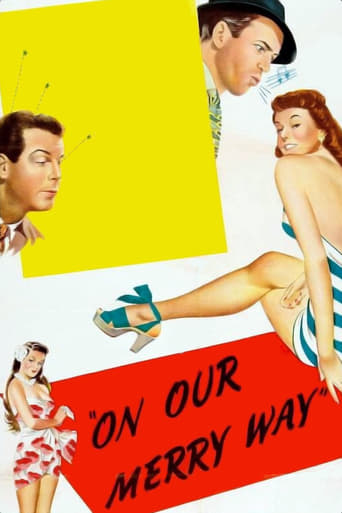
On Our Merry Way (1948)
She's the queen of a Hollywood tong - and a queen, friends, can do nothing wrong! Her public she serves By displaying those curves..She's a miracle in a sarong!
Oliver Pease gets a dose of courage from his wife Martha and tricks the editor of the paper (where he writes lost pet notices) into assigning him the day's roving question. Martha suggests, "Has a little child ever changed your life?" Oliver gets answers from two slow-talking musicians, an actress whose roles usually feature a sarong, and an itinerant cardsharp. In each case the "little child" is hardly innocent: in the first, a local auto mechanic's "baby" turns out to be fully developed as a woman and a musician; in the second, a spoiled child star learns kindness; in the third, the family of a lost brat doesn't want him returned. And Oliver, what becomes of him?
- Date of release
- 1948-02-03
- TMDB
- 5.7 / 10 (19)
- Runtime
- 1h 47m
- Genres
- Comedy, Music, Romance
- Director
- Leslie Fenton, King Vidor
Casting
- Paulette Goddard — Martha Pease
- Burgess Meredith — Oliver M. Pease
- James Stewart — Slim
- Henry Fonda — Lank Solsky
- Harry James — Harry James
- Dorothy Lamour — Gloria Manners
- Victor Moore — Ashton Carrington
- Fred MacMurray — Al
- William Demarest — Floyd
- Hugh Herbert — Eli Hobbs
- Charles D. Brown — Mr. Sadd
- Eduardo Ciannelli — Maxim
Interesting facts
- Box office: $1.5M
On Our Merry Way is a 1948 American comedy film produced by Benedict Bogeaus and Burgess Meredith and released by United Artists. At the time of its release, King Vidor and Leslie Fenton were credited with its direction, although the DVD lists John Huston and George Stevens, who assisted with one of the segments, as well. The screenplay by Laurence Stallings and Lou Breslow, based on an original story by Arch Oboler, is similar in style to that of Tales of Manhattan (1942), another anthology film made up of several vignettes linked by a single theme.
Production notes
The film's original title A Miracle Can Happen was inspired by a segment that was deleted from the film prior to its national release. In it, Charles Laughton portrayed a minister who is asked by a young boy to pay a visit to his dying father (Henry Hull). In an effort to boost the man's spirits, the minister offers an overly dramatic rendition of the Biblical story of David and Saul that sparks the man's full recovery.
The film opened as A Miracle Can Happen in New York City, Philadelphia, and Detroit in February 1948. Reviews were dismal—the New York Daily News described it as "a million dollar cast in a ten-cent film"—and it was pulled from release.
This was the first joint film appearance of lifelong best friends James Stewart and Henry Fonda, although the picture seems to have been completely forgotten in the publicity for their two subsequent movies together a couple of decades later, titled Firecreek (1968) and The Cheyenne Social Club (1970).
Dorothy Lamour spoofed her tropical screen image singing "Queen of the Hollywood Islands," with Frank Loesser providing the music and lyrics.
The song "Baby Made a Change in Me" was written by Skitch Henderson and Donald Kahn.
Read on Wikipedia · Text from Wikipedia, CC BY-SA 4.0. Data from Wikidata.
Recommended
- Let's Make Love 1960 · ★ 6.4
- What's Love Got to Do with It? 2023 · ★ 6.1
- How to Marry a Millionaire 1953 · ★ 6.8
- Watching the Detectives 2007 · ★ 6.3
- Love Is in the Air 2023 · ★ 6.2
- The Merry Widow 1934 · ★ 6.8
- Silk Stockings 1957 · ★ 6.8
- Good Advice 2001 · ★ 5.9
- Easy Virtue 2008 · ★ 6.5
- Marry Me 2022 · ★ 6.6
- The Bachelor and the Bobby-Soxer 1947 · ★ 6.9
- The Fighting Temptations 2003 · ★ 5.8