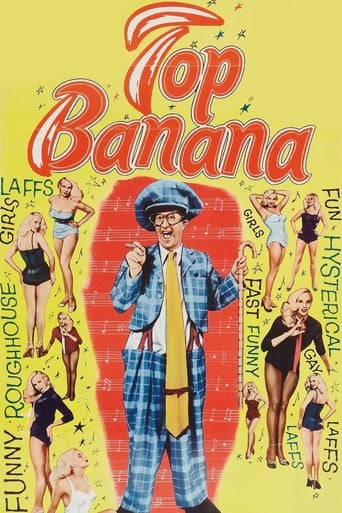
Top Banana (1954)
Jerry Biffle (Phil Silvers) ist der Star einer TV-Comedy-Show, die wegen ihrer zündenden Gags unzählige Fans hat. Kein Wunder, hat Biffle doch mit die besten Gag-Schreiber Amerikas. Seine verrückte Truppe ist aber nicht nur für den professionellen Ablauf der Show verantwortlich. Sie sorgt zudem noch dafür, dass Jerrys Privatleben niemals langweilig wird.
- Erscheinungsdatum
- 1954-02-22
- TMDB
- 5.5 / 10 (4)
- Laufzeit
- 1 Std. 40 Min.
- Genres
- Komödie, Musik, Liebesfilm
- Regie
- Alfred E. Green
Besetzung
- Phil Silvers — Jerry Biffle
- Rose Marie — Betty Dillon
- Danny Scholl — Cliff Lane
- Judy Lynne — Sally Peters
- Jack Albertson — Vic Davis
- Bradford Hatton — Mr. Parker
- Johnny Coy — Tommy Phelps
- Dick Dana — Danny
- Joey Faye — Pinky
- Johnny Trama — Little Man
- Herbie Faye — Moe
- Gloria Smith — Featured Dancer
Wissenswertes
Top Banana is a 1954 American musical film based on the musical of the same name, starring Phil Silvers, and featuring Rose Marie, Judy Lynn, Jack Albertson and Joey Faye, all of whom reprised their roles from the Broadway production of the musical.
Production
After concluding its successful engagement on Broadway in 1952, Top Banana went on tour for a year playing in major cities across the country. Phil Silvers and the cast finished their successful run at the Biltmore Theatre in downtown Los Angeles.
Zugsmith and Peskey decided to film it in 3-D, the popular trend at the time, with the idea in mind that this approach would give the entire audience a choice seat at a top Broadway show, for merely the price of a movie ticket. Zugsmith envisioned this format as a new way to inexpensively film stage shows, and present them in theaters across the country.
The crew developed a rather complicated tracking shot for the opening of the film. The camera would be the person approaching the theater. It would go to the box office and buy tickets, enter the lobby and proceed down to a seat in the third row, center stage. The lights would dim, the overture would play and the show would begin.
Top Banana was photographed with Natural Vision cameras in July 1953, the same rigs that filmed the trend-setting Bwana Devil, as well as other popular 3-D pictures such as House of Wax, Fort Ti, The Charge at Feather River, Devil's Canyon, The Moonlighter, Southwest Passage, and Gog.
While shopping the property around for a distributor, the producers announced they would release the film in a flat version only, citing the public's declining interest in stereoscopic films. In early December, they signed a distribution deal with United Artists. Later that month, the success of some new 3-D releases prompted UA to announce in the trades that a 3-D version would, in fact, be available for exhibitors.
Auf Wikipedia weiterlesen · Text aus Wikipedia, CC BY-SA 4.0. Daten aus Wikidata.
Empfohlen
- Machen wir's in Liebe 1960 · ★ 6.4
- Die Marx Brothers im Kaufhaus 1941 · ★ 6.3
- Seidenstrümpfe 1957 · ★ 6.8
- Die lustige Witwe 1934 · ★ 6.8
- Sneakerella 2022 · ★ 5.9
- The Fighting Temptations 2003 · ★ 5.8
- Der Weg nach Singapur 1940 · ★ 6.4
- Damals im Sommer 1949 · ★ 6.8
- Holiday Harmony 2022 · ★ 6.7
- Easy Virtue - Eine unmoralische Ehefrau 2008 · ★ 6.5
- Groupies bleiben nicht zum Frühstück 2010 · ★ 6.9
- Mitten ins Herz 2007 · ★ 6.5