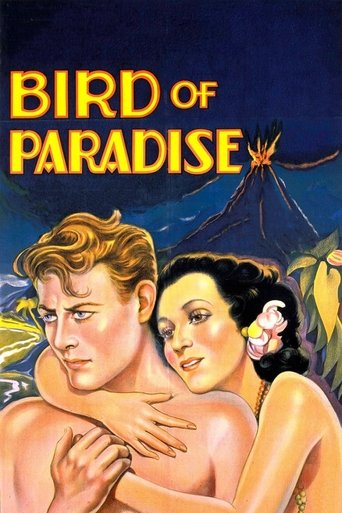
Bird of Paradise (1932)
A drama of forbidden love beyond the pale of white men's morals.
When a young South Seas sailor falls overboard, the beautiful daughter of a Polynesian king dives in and saves his life. Thus begins the romance of Johnny and Luana. Though Luana is promised to another man, Johnny whisks her away, and for a brief time the lovers live very happily together. But, when a local volcano threatens their lives, Luana knows that she must sacrifice herself to the volcanic gods in order to save her island.
- Date of release
- 1932-08-12
- TMDB
- 5.1 / 10 (29)
- Runtime
- 1h 20m
- Genres
- Adventure, Drama, Romance
- Director
- King Vidor
Casting
- Dolores del Río — Luana
- Joel McCrea — Johnny Baker
- John Halliday — Mac
- Richard 'Skeets' Gallagher — Chester
- Bert Roach — Hector
- Lon Chaney Jr. — Thornton
- Wade Boteler — Capitaine Johnson
- Arnold Gray — Walker
- Reginald Simpson — O'Fallon
- Napoleon Pukui — The King
- Agostino Borgato — Medicine Man
- Sofia Ortega — Mahumahu
Interesting facts
Bird of Paradise is a 1932 American pre-Code romantic adventure drama film directed by King Vidor and starring Dolores del Río and Joel McCrea. Based on the 1912 play of the same name by Richard Walton Tully, it was released by RKO Radio Pictures.
Production
Director King Vidor, under contract to M-G-M, was loaned to RKO producer David Selznick (son-in-law to Louis B. Mayer) to make the "South Seas" romance. Filmed on location in Hawaii, Vidor and writer Wells Root arrived on the island territory and began shooting background footage without a completed script (Actors McCrea and del Rio were delayed due to engagements on other projects,) .
The native dance sequences were boom-shot in Hollywood and choreographed by an uncredited Busby Berkeley.
Bird of Paradise was almost the first sound film to utilize a full symphonic score from beginning to end. Producer David O. Selznick and composer Max Steiner had both been experimenting with this idea, while other studios had begun development along similar lines, such the score by Alfred Newman for Samuel Goldwyn's Street Scene.
Read on Wikipedia · Text from Wikipedia, CC BY-SA 4.0. Data from Wikidata.
Recommended
- Tabu: A Story of the South Seas 1931 · ★ 7.1
- The Devil at 4 O'Clock 1961 · ★ 6.3
- One Way Passage 1932 · ★ 7.3
- The Sheik 1921 · ★ 5.9
- Strange Cargo 1940 · ★ 7.0
- Rip Girls 2000 · ★ 6.3
- The Last Song 2010 · ★ 7.2
- Tarzan and the Amazons 1945 · ★ 6.4
- Hellfighters 1968 · ★ 6.3
- Sahara 1983 · ★ 5.9
- Blue Crush 2002 · ★ 6.0
- Elephant Walk 1954 · ★ 5.9