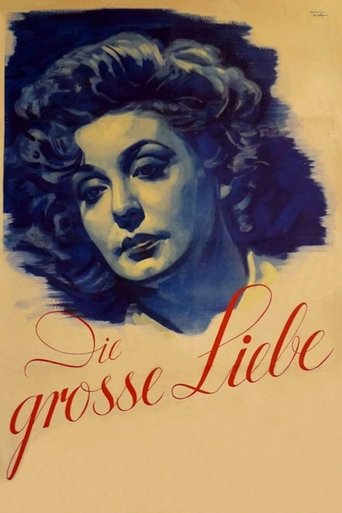
The Great Love (1942)
Die große Liebe
The attractive Oberleutnant Paul Wendlandt is stationed in North Africa as a fighter pilot. While in Berlin to deliver a report he is given a day's leave, and on the stage of the cabaret theatre "Skala" sees the popular Danish singer Hanna Holberg. For Paul it is love at first sight. When Hanna visits friends after the end of the performance, he follows her, and speaks to her in the U-Bahn. After the party in her friends' flat, he accompanies her home and chance throws them further together when an air raid warning forces them to take cover in the air raid shelter. Hanna reciprocates Paul's feelings, but after a night spent together Paul has to return immediately to the front. There now follows a whole series of misunderstandings, and one missed opportunity after another. While Hanna waits in vain for some sign of life from Paul, he is flying on missions in North Africa. When he tries to visit her in her Berlin flat, she is giving a Christmas concert in Paris.
- Date of release
- 1942-06-12
- TMDB
- 6.8 / 10 (16)
- Runtime
- 1h 40m
- Genres
- Drama, Romance
- Director
- Rolf Hansen
Casting
- Zarah Leander — Hanna Holberg
- Grethe Weiser — Kaethe, Hannas Zofe
- Viktor Staal — Paul Wendlandt
- Paul Hörbiger — Alexander Rudnitzky, Komponist
- Wolfgang Preiss — Oberleutnant von Etzdorf
- Hans Schwarz Jr. — Artist Alfred Vanloo
- Victor Janson — Theaterdirektor Mocelli
- Leopold von Ledebur — Herr Westphal
- Julia Serda — Frau Westphal
- Paul Bildt — Unfreundlicher Oberkellner
- Erich Dunskus — Mann, der den Staffelhund mitbringt
- Wilhelm Althaus — Fliegeroffizier Hauptmann Becker
Interesting facts
The Great Love is a 1942 German drama film directed by Rolf Hansen and starring Zarah Leander, Viktor Staal and Grethe Weiser. It premiered in Berlin in 1942 and went on to become the most commercially successful film in the history of the Third Reich. It was shot at the Tempelhof Studios with location shooting taking place in Berlin, Rome and Vienna. The film's sets were designed by the art director Walter Haag.
Production and reception
The interior scenes for "Die große Liebe" were filmed from 23 September 1941 to early October 1941 in the Tobis-Sascha-Studio in Vienna - better known as the Rosenhügel Film Studios - and in the Carl Froelich sound studio in Berlin-Tempelhof. The exterior scenes had been filmed in Berlin and Rome by the middle of March 1942. The film was submitted to the Film Censor's Office on 10 June 1942 (Prüf-Nr. B.
The premiere took place on 12 June 1942 in Berlin, in the Germania-Palast cinema on the Frankfurter Allee and the UFA-Palast am Zoo cinema. Die große Liebe became the greatest commercial film success of the Third Reich. It was seen by 27 million spectators and took 8 million Reichsmarks, having cost 3 million to produce (equivalent to 34 and 13 million 2021 euros).
After the end of World War II the Allied Control Commission forbade the film to be screened. In 1963 however it was submitted to the FSK, who approved its re-release subject to cuts, which were however disregarded by the distributors: the film was shown with a preliminary warning but with no cuts. Further cuts were made in 1980 for release on home video, approved by the FSK for audiences age 6 and up.
The original version of "Die große Liebe" was submitted to the FSK in 1997 and approved for release to audiences over the age of 18. This completely uncut version, running 100 minutes (approximately 97 mins in the PAL video format) is commercially available as a video and DVD in Germany. Distribution rights are now the property of Transit-Film GmbH.
Read on Wikipedia · Text from Wikipedia, CC BY-SA 4.0. Data from Wikidata.
Recommended
- Gloomy Sunday 1999 · ★ 7.7
- A Farewell to Arms 1932 · ★ 6.2
- Middle of the Night 1959 · ★ 7.0
- The French Lieutenant's Woman 1981 · ★ 6.5
- Time Is Up 2021 · ★ 6.5
- Jungle Fever 1991 · ★ 6.4
- Edward II 1991 · ★ 6.3
- London 2005 · ★ 6.0
- Newness 2017 · ★ 6.1
- The Dreamers 2003 · ★ 7.2
- Queen & Slim 2019 · ★ 7.1
- Hungry Hearts 2015 · ★ 6.5