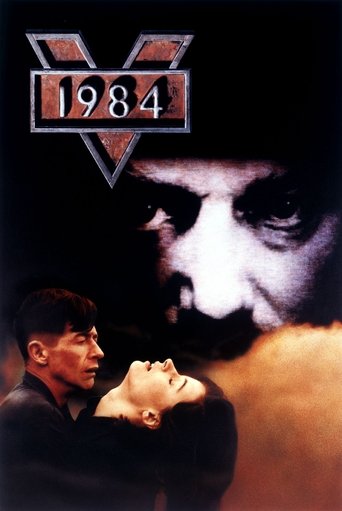
Nineteen Eighty-Four (1984)
George Orwell's terrifying vision comes to the screen.
Winston Smith is a government employee whose job involves the rewriting of history in a manner that casts his fictional country's leaders in a charitable light. His trysts with Julia provide his only measure of enjoyment, but lawmakers frown on the relationship -- and in this closely monitored society, there is no escape from Big Brother.
- Date of release
- 1984-11-09
- TMDB
- 6.8 / 10 (1760)
- Runtime
- 1h 53m
- Genres
- Drama, Science Fiction, Thriller
- Director
- Michael Radford
Casting
- John Hurt — Winston Smith
- Richard Burton — O'Brien
- Suzanna Hamilton — Julia
- Cyril Cusack — Charrington
- Gregor Fisher — Parsons
- James Walker — Syme
- Andrew Wilde — Tillotson
- David Cann — Martin
- Peter Frye — Rutherford
- Roger Lloyd Pack — Waiter
- David Trevena — Tillotson's Friend
- Anthony Benson — Jones
Interesting facts
- Box office: $8.4M
- Budget: £5.5M
- Based on: Nineteen Eighty-Four
Nineteen Eighty-Four is a 1984 British dystopian film written and directed by Michael Radford, based on George Orwell's 1949 novel. Starring John Hurt, Richard Burton, Suzanna Hamilton and Cyril Cusack, it follows the life of Winston Smith (Hurt), a low-ranking civil servant in a war-torn London in Oceania, a totalitarian superstate ruled by Ingsoc and its leader Big Brother. Smith struggles to maintain his sanity and his grip on reality as the regime's overwhelming power and influence persecute individualism and individual thinking on both a political and a personal level.
Production
In the winter of 1983 the director Michael Radford asked his producer to try to obtain the rights to Orwell's novel, with low expectations that they were available. It turned out that the rights were held by Marvin Rosenblum, a lawyer in Chicago who had been trying on his own to get such a film produced.
For the role of O'Brien, Paul Scofield was originally contracted to play the part, but had to withdraw after sustaining a broken leg while filming The Shooting Party. Anthony Hopkins, Sean Connery and Rod Steiger were all then considered. Richard Burton, who was living in Haiti, joined the production six weeks into its shooting schedule and insisted on his costume of a boiler suit being hand-made for him in Savile Row.
Some sources claim that principal photography began on 19 March 1984, ending later the same year in October 1984. It was released that same month, however, and a title card at the end explicitly states that it "was photographed in and around London during the period April–June 1984, the exact time and setting imagined by Orwell." The budget was originally £2.5 million, but this rose during filming and additional funds were required.
The disused Battersea Power Station in Wandsworth served as the façade for the Victory Mansions, and the Beckton Gas Works in the Docklands of Newham was used as the setting for the proletarian zones. The pawnshop exterior, a pub scene and a scene with a prostitute were filmed in Cheshire Street in the East End of London, an area Orwell had visited and commented on in his first book, Down and Out in Paris and London.
Radford and the cinematographer Roger Deakins originally wanted to shoot the film in black and white, but the financial backers of the production, Virgin Films, opposed this idea. Instead, Deakins used a film processing technique called bleach bypass to give a distinctive washed-out look to the film's color values.
Read on Wikipedia · Text from Wikipedia, CC BY-SA 4.0. Data from Wikidata.
Recommended
- Equilibrium 2002 · ★ 7.1
- The Running Man 1987 · ★ 6.5
- V for Vendetta 2006 · ★ 7.9
- Land of the Blind 2006 · ★ 5.8
- The Handmaid's Tale 1990 · ★ 6.1
- A Scanner Darkly 2006 · ★ 6.8
- Zardoz 1974 · ★ 5.9
- Children of Men 2006 · ★ 7.6
- The Maze Runner 2014 · ★ 7.2
- The Running Man 2025 · ★ 6.7
- 2073 2024 · ★ 6.7
- Fortress 1992 · ★ 6.1