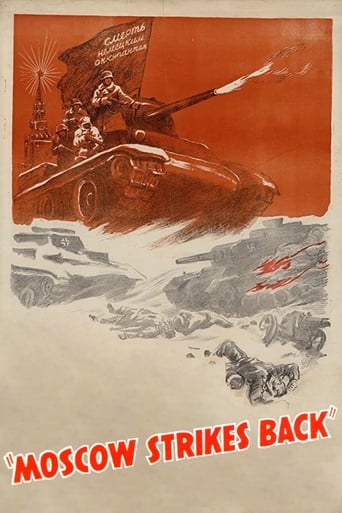
Разгром немецких войск под Москвой (1942)
A Soviet documentary chronicling the Battle of Moscow (October 1941 – January 1942), when Red Army forces repelled the German advance on the capital. Shot by numerous frontline cameramen, it combines harrowing footage of combat and civilian suffering with scenes of Nazi atrocities, framed against themes of Russian heroism and cultural survival. Originally released under the title Defeat of the German Armies Near Moscow, the English-language version, narrated by Edward G. Robinson, was retitled Moscow Strikes Back. The film won the 1943 Academy Award for Best Documentary. Warning: contains graphic images.
- Data lansării
- 1942-02-23
- TMDB
- 5.6 / 10 (17)
- Durată
- 55 min
- Genuri
- Documentar, Război
- Regizor
- Илья Копалин, Леонид Варламов
Distribuție
- N. Dubravin — Narrator(voice)
- Edward G. Robinson — Narrator (English version) (voice)
Curiozități
- Premii: 1 · Nominalizări: 1. Inclusiv: Premiul Oscar pentru cel mai bun film documentar
Moscow Strikes Back is a Soviet documentary film about the Battle of Moscow between October 1941 and January 1942. It was directed by Ilya Kopalin and Leonid Varlamov. It was one of four films that won a 1942 Academy Award for Best Documentary Feature.
Production
Moscow Strikes Back was produced as "Project 6004; Information film #5", under the working titles of "Know Your Ally: Russia" and "War in the East". Preparation of the scenario started on 1 April 1942. A print of the completed film was provided to the Soviet authorities on 9 July 1943. Much of the footage was new; some was from American sources including newsreels, and some from captured German sources.
The film is said to have been translated into several languages for showing in different parts of the Soviet Union.
The English version's narration was written by Albert Maltz, with uncredited writing by Jay Leyda, and Elliot Paul. It was distributed by Artkino Pictures and Republic Pictures. The film was first shown in the New York on 15 August 1942 at the Globe Theatre. The New York Times credits it as: "Russian documentary produced by the Central Studios, Moscow, USSR; English commentary by Albert Maltz, narrated by Edward G.
A French version, translated by André David, was narrated by Charles Boyer.
Citește pe Wikipedia · Text din Wikipedia, CC BY-SA 4.0. Date din Wikidata.
Recomandate
- The Soviet Story 2008 · ★ 7.3
- La 2000 de metri de Andriivka 2025 · ★ 8.1
- The Battle of San Pietro 1945 · ★ 6.1
- Father Soldier Son 2020 · ★ 6.5
- Pentru Sama 2019 · ★ 8.2
- Why We Fight: Prelude to War 1942 · ★ 6.4
- 20 de zile în Mariupol 2023 · ★ 8.1
- Triumph Over Violence 1965 · ★ 7.5
- The Battle of Midway 1942 · ★ 5.9
- They Shall Not Grow Old 2018 · ★ 7.8
- The Age of Stupid 2009 · ★ 6.6
- The Kill Team 2013 · ★ 6.9