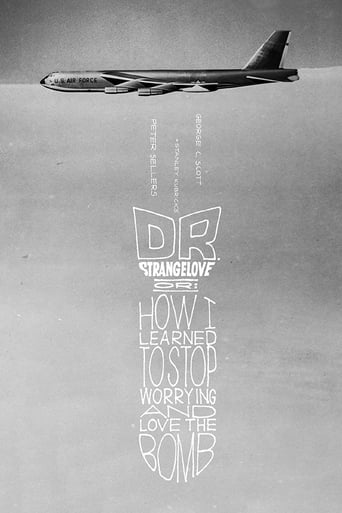
Dr. Strangelove or: How I Learned to Stop Worrying and Love the Bomb (1964)
The hot-line suspense comedy.
After the insane General Jack D. Ripper initiates a nuclear strike on the Soviet Union, a war room full of politicians, generals and a Russian diplomat all frantically try to stop it.
- Date of release
- 1964-01-29
- TMDB
- 8.1 / 10 (6514)
- Runtime
- 1h 35m
- Genres
- Comedy, War
- Director
- Stanley Kubrick
Casting
- Peter Sellers — Group Capt. Lionel Mandrake / President Merkin Muffley / Dr. Strangelove
- George C. Scott — General 'Buck' Turgidson
- Sterling Hayden — Brigadier General Jack D. Ripper
- Keenan Wynn — Colonel Bat Guano
- Slim Pickens — Major "King" Kong
- Peter Bull — Botschafter De Sadesky
- James Earl Jones — Lt. Lothar Zogg
- Tracy Reed — Miss Scott
- Jack Creley — Mr. Staines
- Frank Berry — Lt. Dietrich
- Robert O'Neil — Adm. Randolph
- Glenn Beck — Lt. Kivel
Interesting facts
- Box office: $9.5M
- Budget: $1.8M
- Earned 5.3× its budget
- Based on: Red Alert
- Filmed in: Iceland, Arctic, Banff National Park, Rocky Mountains, Shepperton Studios, Okaloosa County and 4 more
- Awards: 6 · Nominations: 10. Including: Bodil Award for Best Non-American Film; New York Film Critics Circle Award for Best Director; BAFTA Award for Best British Film; BAFTA Award for Best Film
Dr. Strangelove or: How I Learned to Stop Worrying and Love the Bomb is a 1964 political satire black comedy film co-written, produced, and directed by Stanley Kubrick. It is loosely based on the thriller novel Red Alert (1958) by Peter George, who wrote the screenplay with Kubrick and Terry Southern. Financed and released by Columbia Pictures, the film was a co-production between the United States and the United Kingdom.
Production
Stanley Kubrick started with nothing but a vague idea to make a thriller about a nuclear accident that built on the widespread Cold War fear for survival. While doing research, Kubrick gradually became aware of the subtle and paradoxical "balance of terror" between nuclear powers. At Kubrick's request, Alastair Buchan (the head of the Institute for Strategic Studies) recommended the thriller novel Red Alert by Peter George.
In collaboration with George, Kubrick started writing a screenplay based on the book. While writing the screenplay, they benefited from some brief consultations with Schelling and later, Herman Kahn. In following the tone of the book, Kubrick originally intended to film the story as a serious drama. However, he began to see comedy inherent in the idea of mutual assured destruction as he wrote the first draft.
The title of the film satirically references Dale Carnegie's How to Stop Worrying and Start Living. Among the other titles that Kubrick initially considered were Dr. Doomsday or: How to Start World War III Without Even Trying, Dr. Strangelove's Secret Uses of Uranus, and Wonderful Bomb. After deciding to make the film a black comedy, Kubrick brought in Terry Southern as a co-writer in late 1962.
Dr. Strangelove was filmed at Shepperton Studios, near London, as Sellers was in the middle of a divorce at the time and unable to leave England. The sets occupied three main sound stages: the Pentagon War Room, the B-52 Stratofortress bomber and the last one containing both the motel room and General Ripper's office and outside corridor. The studio's buildings were also used as the Air Force base exterior.
For the War Room, Ken Adam first designed a two-level set which Kubrick initially liked, only to decide later that it was not what he wanted. Adam next began work on the design that was used in the film, an expressionist set that was compared with The Cabinet of Dr. Caligari and Fritz Lang's Metropolis.
Read on Wikipedia · Text from Wikipedia, CC BY-SA 4.0. Data from Wikidata.
Recommended
- Hot Shots! 1991 · ★ 6.6
- The Naked Gun 2½: The Smell of Fear 1991 · ★ 6.8
- Hot Shots! Part Deux 1993 · ★ 6.6
- The Bed Sitting Room 1969 · ★ 5.9
- Mars Attacks! 1996 · ★ 6.4
- Johnny English Strikes Again 2018 · ★ 6.3
- Family Guy Presents: Blue Harvest 2007 · ★ 7.4
- Mayday 2026 · ★ 7.8
- The Mouse That Roared 1959 · ★ 6.4
- The War Game 1966 · ★ 7.7
- Undercover Brother 2002 · ★ 5.9
- Naked Gun 33⅓: The Final Insult 1994 · ★ 6.5