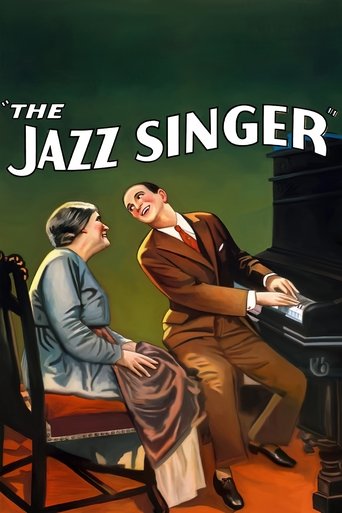
The Jazz Singer (1927)
Hear him sing Mammy, Toot Toot Tootsie, My Gal Sal, Mother I Still Have You.
A young Jewish man is torn between tradition and individuality when his old-fashioned family objects to his career as a jazz singer. This is the first full length feature film to use synchronized sound, and is the original film musical.
- Date of release
- 1927-10-06
- TMDB
- 6.1 / 10 (266)
- Runtime
- 1h 36m
- Genres
- Drama, Music
- Director
- Alan Crosland
Casting
- Al Jolson — Jakie Rabinowitz
- May McAvoy — Mary Dale
- Warner Oland — Cantor Rabinowitz
- Eugenie Besserer — Sara Rabinowitz
- Otto Lederer — Moisha Yudelson
- Robert Gordon — Young Jakie Rabinowitz
- Richard Tucker — Harry Lee
- Yossele Rosenblatt — Cantor Rosenblatt
- William Demarest — Buster Billings (uncredited)
- John Miljan — Host (uncredited)
- Roscoe Karns — Agent (uncredited)
- Anders Randolf — Dillings (uncredited)
Interesting facts
- Box office: $3M
- Budget: $422K
- Earned 7.1× its budget
- Based on: The Jazz Singer
- Filmed in: Old Warner Brothers Studios
- Awards: 0 · Nominations: 1
The Jazz Singer is a 1927 American part-talkie musical drama film directed by Alan Crosland and produced by Warner Bros. Pictures. It is the first feature-length motion picture with both synchronized recorded music and lip-synchronous singing and speech. Its release heralded the commercial ascendance of sound films and effectively marked the end of the silent film era with the Vitaphone sound-on-disc system, featuring six songs performed by Al Jolson. Based on the 1925 play of the same title by Samson Raphaelson, the plot was adapted from his short story "The Day of Atonement".
Production
On April 25, 1917, Samson Raphaelson, a native of New York City's Lower East Side and a University of Illinois undergraduate, attended a performance of the musical Robinson Crusoe, Jr. in Champaign, Illinois. The star of the show was a thirty-year-old singer, Al Jolson, a Lithuanian-born Jew who performed in blackface.
A few years later, pursuing a professional literary career, Raphaelson wrote "The Day of Atonement", a short story about a young Jew named Jakie Rabinowitz, based on Jolson's real life. The story was published in January 1922 in Everybody's Magazine. Raphaelson later adapted the story into a stage play, The Jazz Singer. A straight drama, all the singing in Raphaelson's version takes place offstage.
But the plans to make the film with Jessel would fall through, for multiple reasons. Jessel's contract with Warner Bros. had not anticipated that the movie they had particularly signed him for would be made with sound (he'd made a modestly budgeted, silent comedy in the interim). When Warner had hits with two Vitaphone, though dialogue-less, features in late 1926, The Jazz Singer production had been reconceived.
According to performer Eddie Cantor, as negotiations between Warner Bros. and Jessel floundered, Jack L. Warner and the studio's production chief, Darryl Zanuck, called to see if he was interested in the part. Cantor, a friend of Jessel's, responded that he was sure any differences with the actor could be worked out and offered his assistance.
While many earlier sound films had dialogue, all were short subjects. D. W. Griffith's feature Dream Street (1921) was shown in New York with a single singing sequence and crowd noises, using the sound-on-disc system Photokinema. The film was preceded by a program of sound shorts, including a sequence with Griffith speaking directly to the audience, but the feature itself had no talking scenes.
Read on Wikipedia · Text from Wikipedia, CC BY-SA 4.0. Data from Wikidata.
Recommended
- I Never Sang for My Father 1970 · ★ 6.7
- Bravetown 2015 · ★ 6.7
- Grace Unplugged 2013 · ★ 6.0
- TÁR 2022 · ★ 7.1
- A Taste of Honey 1961 · ★ 7.1
- Fences 2016 · ★ 6.9
- A Chorus Line 1985 · ★ 6.2
- Great Balls of Fire! 1989 · ★ 6.3
- tick, tick... BOOM! 2021 · ★ 7.6
- Newsies 1992 · ★ 6.7
- Killer's Kiss 1955 · ★ 6.3
- What Maisie Knew 2013 · ★ 7.1