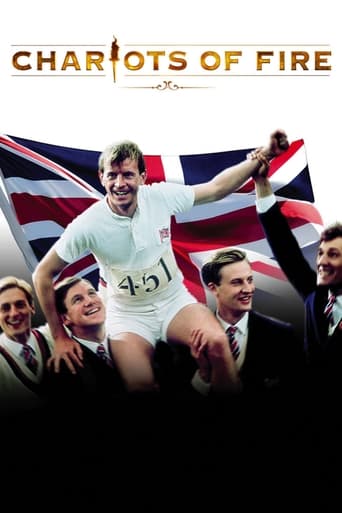
Chariots of Fire (1981)
This is the story of two men who run, not to run, but to prove something to the world. They will sacrifice anything to achieve their goals... except their honor.
In the class-obsessed and religiously divided UK of the early 1920s, two determined young runners train for the 1924 Paris Olympics. Eric Liddell, a devout Christian born to Scottish missionaries in China, sees running as part of his worship of God's glory and refuses to train or compete on the Sabbath. Harold Abrahams overcomes anti-Semitism and class bias, but neglects his beloved sweetheart in his single-minded quest.
- Date of release
- 1981-05-15
- TMDB
- 6.8 / 10 (1099)
- Runtime
- 2h 3m
- Genres
- Drama, History
- Director
- Hugh Hudson
Casting
- Ben Cross — Harold Abrahams
- Ian Charleson — Eric Liddell
- Cheryl Campbell — Jennie Liddell
- Alice Krige — Sybil Gordon
- Nigel Havers — Lord Andrew Lindsay
- Ian Holm — Sam Mussabini
- Nicholas Farrell — Aubrey Montague
- Daniel Gerroll — Henry Stallard
- John Gielgud — Master of Trinity
- Lindsay Anderson — Master of Caius
- Nigel Davenport — Lord Birkenhead
- Dennis Christopher — Charles Paddock
Interesting facts
- Box office: $59.3M
- Budget: $5.5M
- Earned 10.8× its budget
- Filmed in: Edinburgh
- Awards: 6 · Nominations: 7. Including: Academy Award for Best Picture; Academy Award for Best Writing, Original Screenplay; Academy Award for Best Costume Design; Academy Award for Best Original Score
Chariots of Fire is a 1981 historical sports drama film directed by Hugh Hudson, written by Colin Welland and produced by David Puttnam. It is based on the true story of two British athletes in the 1924 Olympics: Eric Liddell, a devout Scottish Christian who runs for the glory of God, and Harold Abrahams, an English Jew who runs to overcome prejudice. Ian Charleson and Ben Cross star as Liddell and Abrahams respectively, alongside Nicholas Farrell, Nigel Havers, Daniel Gerroll, Ian Holm, John Gielgud, Lindsay Anderson, Cheryl Campbell, Alice Krige, Brad Davis and Dennis Christopher in supporting roles.
Production
Producer David Puttnam was looking for a story in the mould of A Man for All Seasons (1966), regarding someone who follows his conscience, and felt that sport provided clear situations in this sense. He discovered Eric Liddell's story by accident in 1977, when he happened upon An Approved History of the Olympic Games, a reference book on the Olympics, while housebound from the flu, in a rented house in Malibu.
Screenwriter Colin Welland, commissioned by Puttnam, did an enormous amount of research for his Academy Award-winning script. Among other things, he took out advertisements in London newspapers seeking memories of the 1924 Olympics, went to the National Film Archives for pictures and footage of the 1924 Olympics, and interviewed everyone involved who was still alive.
Welland's original script also featured, in addition to Eric Liddell and Harold Abrahams, a third protagonist, 1924 Olympic gold medallist Douglas Lowe, who was presented as a privileged aristocratic athlete. However, Lowe refused to have anything to do with the film, and his character was written out and replaced by the fictional character of Lord Andrew Lindsay.
Initial financing towards development costs was provided by Goldcrest Films, who then sold the project to Mohamed Al-Fayed's Allied Stars, but kept a percentage of the profits.
Ian Charleson wrote Eric Liddell's speech to the post-race workingmen's crowd at the Scotland v. Ireland races. Charleson, who had studied the Bible intensively in preparation for the role, told director Hugh Hudson that he didn't feel the portentous and sanctimonious scripted speech was either authentic or inspiring. Hudson and Welland allowed him to write words he personally found inspirational instead.
Read on Wikipedia · Text from Wikipedia, CC BY-SA 4.0. Data from Wikidata.
Recommended
- Overcomer 2019 · ★ 7.7
- Seabiscuit 2003 · ★ 7.1
- Race 2016 · ★ 7.3
- Young Woman and the Sea 2024 · ★ 7.9
- The Eyes of Tammy Faye 2021 · ★ 6.4
- Shirley 2024 · ★ 6.6
- The Girl Who Believes in Miracles 2021 · ★ 7.4
- Rudy 1993 · ★ 7.4
- Mary 2024 · ★ 6.3
- JOY 2024 · ★ 6.9
- Journey to Bethlehem 2023 · ★ 7.7
- We Are Marshall 2006 · ★ 6.9