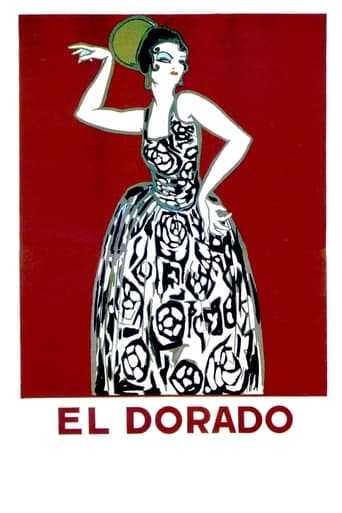
El Dorado (1921)
In Granada in Spain, Sibilla works as a dancer in a squalid cabaret called El Dorado, struggling to earn enough to care for her sick child. The boy's father Estiria, a prominent citizen, refuses them both help and recognition, fearful of jeopardising the engagement of his adult daughter Iliana to a wealthy nobleman. Iliana however slips away from her engagement party to meet her real lover Hedwick, a Swedish painter. Sibilla, in desperation after a further rejection by Estiria, sees an opportunity to blackmail him by locking the lovers overnight in their meeting-place in the Alhambra.
- Date of release
- 1921-10-28
- TMDB
- 6.7 / 10 (19)
- Runtime
- 1h 38m
- Genres
- Drama
- Director
- Marcel L'Herbier
Casting
- Ève Francis — Sibilla
- Jaque Catelain — Hedwick
- Marcelle Pradot — Iliana
- Philippe Hériat — Joao, le bouffon
- Claire Prélia — La comtesse suédoise
- Georges Paulais — Esteria
- Édith Réal — Conception
- Max Dhartigny — Le patron de l'El Dorado
- Émile Saint-Ober — L'aveugle
- Jeanne Bérangère — Flore
- Michel Duran
- Noémi Seize
Interesting facts
El Dorado is a French silent film directed in 1921 by Marcel L'Herbier. The film was notable for integrating a number of technical innovations into its narrative of a "cinematic melodrama". It achieved considerable success on its release, as a ground-breaking film that was distinctively French at a time when the cinema was felt to be dominated by American productions.
Production
A substantial part of the film was to be shot on location in Granada, Seville and the Sierra Nevada, and filming began in March 1921. For the first time ever, permission had been granted for a film company to shoot inside the Alhambra palace and L'Herbier gave prominent place to its gardens, fountains and geometric architectural patterns. These became some of the film's most memorable images.
With his principal cameraman Georges Lucas, L'Herbier created a number of optical effects during filming. When Sibilla is first introduced among the other dancers on stage, a partial blurring of the image places her out-of-focus while those around her are sharply defined, an effect repeated in her subsequent dance to suggest that she herself is not fully focussed on her surroundings because her mind is preoccupied with the plight of her son.
L'Herbier was an ardent advocate of colour tinting of the finished photographic image, and he devised an elaborate scheme of colouring to enhance the effect of different scenes and shots, and sometimes to clarify the shift between the present and a past flashback. (A surviving print held by the Cinémathèque Française preserves these tinted effects.)
L'Herbier regarded the musical accompaniment of a film as being supremely important, and in El Dorado he sought to produce a closer integration between image and music than had been achieved before. He commissioned the young composer Marius-François Gaillard (who was only 21) to compose an orchestral score which was based upon the final cut of the film.
L'Herbier enjoyed complete artistic freedom during filming but his relations with his producer Léon Gaumont deteriorated as the schedule and the budget both exceeded expectations. Gaumont was not impressed by the 'artistic' visual devices of blurred and distorted images.
Read on Wikipedia · Text from Wikipedia, CC BY-SA 4.0. Data from Wikidata.
Recommended
- What Maisie Knew 2013 · ★ 7.1
- The Padre 2018 · ★ 5.9
- Kisses 2008 · ★ 7.1
- The Nest 2020 · ★ 6.1
- Hands of Stone 2016 · ★ 6.6
- Battle of the Year 2013 · ★ 6.8
- The Young One 1960 · ★ 7.0
- Home Run 2013 · ★ 6.2
- Lorelei 2020 · ★ 6.0
- Killer's Kiss 1955 · ★ 6.3
- Vanya on 42nd Street 1994 · ★ 6.7
- Hardball 2001 · ★ 6.5