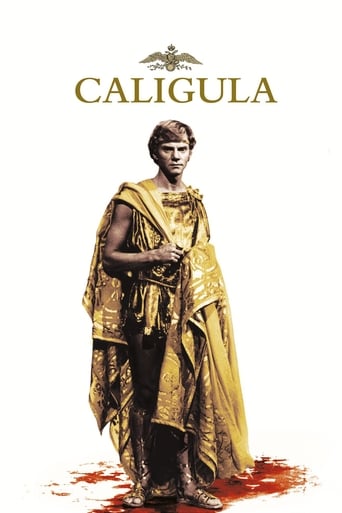
Caligula (1979)
Caligola
Absolute power corrupts
After the death of the paranoid emperor Tiberius, Caligula, his heir, seizes power and plunges the empire into a bloody spiral of madness and depravity.
- Date of release
- 1979-08-14
- TMDB
- 6.0 / 10 (1051)
- Runtime
- 2h 36m
- Genres
- Drama, History
- Director
- Tinto Brass
Casting
- Malcolm McDowell — Caligula
- Teresa Ann Savoy — Drusilla
- Helen Mirren — Caesonia
- Peter O'Toole — Tiberius
- John Steiner — Longinus
- Guido Mannari — Macro
- Paolo Bonacelli — Chaerea
- Leopoldo Trieste — Charicles
- Giancarlo Badessi — Claudius
- Mirella D'Angelo — Livia
- Anneka Di Lorenzo — Messalina
- Lori Wagner — Agrippina
Interesting facts
- Box office: $23.4M
Caligula is a 1979 historical drama film about the rise and fall of Roman Emperor Caligula. The film stars Malcolm McDowell in the title role, alongside Teresa Ann Savoy, Helen Mirren, Peter O'Toole, John Steiner, and John Gielgud.
Production
The men's magazine Penthouse had long been involved in film funding, helping invest in films made by other studios, including Chinatown, The Longest Yard and The Day of the Locust, but it had never produced a film on its own. The magazine's founder Bob Guccione wanted to produce an explicit adult film within a feature film narrative that had high production values; he decided to produce a film about the rise and fall of the Roman emperor Caligula…
Elaborate sets were built by production designer Danilo Donati, who also designed the film's costumes, jewelry, hairstyles, wigs, and makeup. Several mainstream actors were cast, Guccione intending to make a film that he felt, like Citizen Kane, would be a landmark in cinematic history. Guccione offered directing duties to John Huston and Lina Wertmüller, both of whom rejected the film.
In an interview for Time magazine, Vidal said that in film production, directors were "parasites" and a film's author was its screenwriter; in response, Brass demanded Vidal's removal from the set and Guccione agreed. Guccione considered the film to be a "collective effort, involving the input of a great number of artists and craftsmen", and the director to be the leader of a "team effort".
The film's primary theme is "absolute power corrupts absolutely". Vidal's script presented Caligula as a good man driven to madness by absolute power; Brass's screenplay envisioned Caligula as a "born monster". In The Encyclopedia of Epic Films, author Djoymi Baker describes Brass's screenplay as "an antiepic with an antihero, on a path of self-inflicted, antisocial descent".
Orson Welles was initially offered $1 million to star as Tiberius, a figure which would have been his highest ever salary, but he refused on moral grounds when he read the script. Gore Vidal expressed disbelief that this could have ever been the case as he felt that Welles could not have portrayed Tiberius, but then recalled Kenneth Tynan remarking to him at the time that Welles was "upset" by the script.
Read on Wikipedia · Text from Wikipedia, CC BY-SA 4.0. Data from Wikidata.
Recommended
- Fellini's Casanova 1976 · ★ 6.9
- Auto Focus 2002 · ★ 6.4
- Shame 2011 · ★ 6.9
- The Devil's Double 2011 · ★ 6.7
- The Krays 1990 · ★ 6.1
- Nymphomaniac: Vol. I 2013 · ★ 6.9
- The Professor 1986 · ★ 7.1
- Flesh + Blood 1985 · ★ 6.6
- Nymphomaniac: Vol. II 2013 · ★ 6.7
- Walking with the Enemy 2014 · ★ 6.3
- The Valachi Papers 1972 · ★ 6.5
- Loro 1 2018 · ★ 6.8