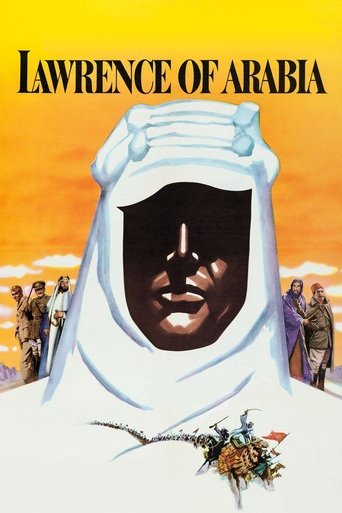
Lawrence of Arabia (1962)
Nothing is written.
During World War I, English officer Thomas Edward 'T.E.' Lawrence sets out to unite and lead the diverse, often warring, Arab tribes to fight the Turks.
- Date of release
- 1962-12-11
- TMDB
- 8.0 / 10 (3656)
- Runtime
- 3h 48m
- Genres
- Adventure, History, War
- Director
- David Lean
Casting
- Peter O'Toole — T.E. Lawrence
- Alec Guinness — Prince Feisal
- Anthony Quinn — Auda abu Tayi
- Jack Hawkins — General Edmund Allenby
- Omar Sharif — Sherif Ali
- José Ferrer — Turkish Bey
- Anthony Quayle — Colonel Harry Brighton
- Claude Rains — Mr. Dryden
- Arthur Kennedy — Jackson Bentley
- Donald Wolfit — General Archibald Murray
- I.S. Johar — Gasim
- Gamil Ratib — Majid
Interesting facts
- Box office: $45.7M
- Budget: $15M
- Earned 3× its budget
- Based on: Seven Pillars of Wisdom
- Filmed in: Spain, London, Morocco, Jordan, and Almería Province
- Awards: 9 · Nominations: 10. Including: Academy Award for Best Picture; Silver nugget for the best foreign film; Academy Award for Best Director; Academy Award for Best Cinematography, Color
Lawrence of Arabia is a 1962 epic biographical drama film directed by David Lean and produced by Sam Spiegel through the latter's British company Horizon Pictures and distributed by Columbia Pictures. It is based on the life of T. E. Lawrence and his 1926 book Seven Pillars of Wisdom. Lawrence of Arabia introduces Peter O'Toole as Lawrence, with Alec Guinness playing Prince Faisal. It also stars Jack Hawkins, Anthony Quinn, Omar Sharif, Anthony Quayle, Claude Rains, Jose Ferrer and Arthur Kennedy. The screenplay was written by Robert Bolt and Michael Wilson.
Production
Previous films about T. E. Lawrence had been planned but had not been made. In the 1940s, Alexander Korda was interested in filming Seven Pillars of Wisdom with Laurence Olivier, Leslie Howard, or Robert Donat as Lawrence, but had to pull out owing to financial difficulties. David Lean had been approached to direct a 1952 version for the Rank Organisation, but the project fell through.
Lean and Sam Spiegel had worked together on The Bridge on the River Kwai and decided to collaborate again. For a time, Lean was interested in a biopic of Gandhi, with Alec Guinness to play the title role and Emeric Pressburger writing the screenplay. He eventually lost interest in the project, despite extensive pre-production work, including location scouting in India and a meeting with Jawaharlal Nehru. Lean then returned his attention to T. E.
Michael Wilson wrote the original draft of the screenplay. Lean was dissatisfied with Wilson's work, primarily because his treatment focused on the historical and political aspects of the Arab Revolt. Spiegel hired Robert Bolt to re-write the script to make it a character study of Lawrence. Many of the characters and scenes are Wilson's invention, but virtually all of the dialogue in the finished film was written by Bolt.
Lean reportedly watched John Ford's 1956 film The Searchers to help him develop ideas as to how to shoot the film. Several scenes directly recall Ford's film, most notably Ali's entrance at the well and the composition of many of the desert scenes and the dramatic exit from Wadi Rum. Lean biographer Kevin Brownlow noted a physical similarity between Wadi Rum and Ford's Monument Valley.
In an interview with The Washington Post in 1989, Lean said that Lawrence and Ali were written as being in a gay relationship. When asked about whether the film was "pervasively homoerotic", Lean responded:
Read on Wikipedia · Text from Wikipedia, CC BY-SA 4.0. Data from Wikidata.
Recommended
- Khartoum 1966 · ★ 6.4
- War Horse 2011 · ★ 7.3
- The Guns of Navarone 1961 · ★ 7.3
- The Alamo 1960 · ★ 7.1
- King Arthur 2004 · ★ 6.3
- Lion of the Desert 1981 · ★ 7.3
- Queen of the Desert 2015 · ★ 5.8
- Henry V 1944 · ★ 6.7
- The Wind and the Lion 1975 · ★ 6.5
- The Charge of the Light Brigade 1968 · ★ 6.2
- The Four Feathers 1939 · ★ 7.1
- Kelly's Heroes 1970 · ★ 7.4