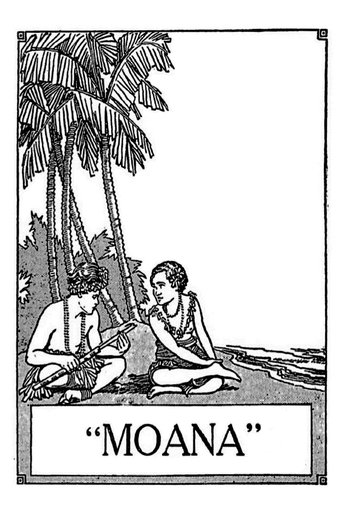
Moana (1926)
In the South Seas, Samoan village life is portrayed with a painterly eye. Blending ethnographic detail with a romanticized 'Gauguin idyll', the film celebrates daily rituals, communal traditions, and the passage into adulthood, suffused pride of beauty and pride of strength.
- Date of release
- 1926-01-07
- TMDB
- 6.7 / 10 (38)
- Runtime
- 1h 38m
- Genres
- Documentary
- Director
- Robert Flaherty, Frances H. Flaherty
Casting
- Ta'avale — Moana
- Fa'amgase — Moana's Fiancé
- Tama — Moana's Father
- T'ugaita — Moana's Mother
- Pe'a — Moana's Younger Brother
- Leupenga — Moana's Older Brother
Interesting facts
Moana is a 1926 American silent documentary film, or more strictly a work of docufiction, which was directed by Robert J. Flaherty, creator of Nanook of the North (1922), and his wife Frances H. Flaherty. A reviewer of the film coined the now-common term "documentary".
Production
Moana was filmed in Samoa (then under the Western Samoa Trust Territory) in the villages of Safune district on the island of Savai'i. The name of the lead male character, Moana, means 'deep sea, deep water' in the Samoan language. In making the film, Flaherty lived with his wife and collaborator Frances H. Flaherty and their three daughters in Samoa for more than a year.
Hoping that Flaherty could repeat the success of Nanook, Paramount Pictures sent him to Samoa to capture the traditional life of the Polynesians on film. Flaherty reportedly arrived with 16 tons of filmmaking equipment. This included both a regular movie camera and a Prizma color camera, as Flaherty hoped to film some footage in that color process, but the Prizmacolor camera malfunctioned.
Moana is thought to be the first feature film made with panchromatic black-and-white film rather than the orthochromatic film commonly used at the time in Hollywood feature films. Flaherty developed his film as he went along, in a cave on Savai'i. In the process, he inadvertently poisoned himself and required treatment after he drank water from the cave that contained silver nitrate, which washed off the film stock.
As in the earlier Nanook (and his later film, Man of Aran), Flaherty went well beyond recording the life of the people of Samoa as it happened. He followed his usual procedure of "casting" locals whom he considered potentially photogenic performers into "roles", including creating fictitious family relationships.
He also, as in the other films, on occasion set up scenes in which exotic earlier practices were re-enacted as if still current. In Nanook and Man of Aran, it included setting up anachronistic hunting sequences. In Moana, at a time when Samoans were typically wearing modern Western-style clothing under the influence of Christian missionaries, Flaherty persuaded his performers to don traditional tapa cloth costumes (made from the bark of the paper…
Read on Wikipedia · Text from Wikipedia, CC BY-SA 4.0. Data from Wikidata.
Recommended
- Baraka 1992 · ★ 8.2
- Naqoyqatsi 2002 · ★ 6.2
- Powaqqatsi 1988 · ★ 7.2
- Dolphin Reef 2018 · ★ 6.8
- David Byrne's American Utopia 2020 · ★ 7.5
- Girl Rising 2013 · ★ 7.0
- Ex Libris: The New York Public Library 2017 · ★ 6.4
- Deepsea Challenge 3D 2014 · ★ 6.6
- Machete Maidens Unleashed! 2010 · ★ 6.6
- Daft Punk Unchained 2015 · ★ 7.2
- Love, Marilyn 2013 · ★ 6.5
- OLIVIA RODRIGO: driving home 2 u (a SOUR film) 2022 · ★ 7.8