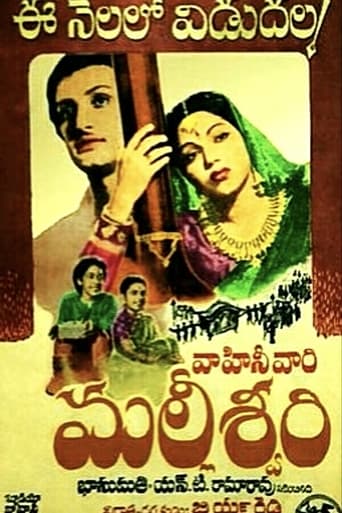
Malliswari (1951)
During the days of the Vijayanagara Empire there was a system to bring willing women to the royal palace and render them official residents. This was called 'Rani Vasam'. According to this royal tradition, they sent palanquins to their houses, after they presented the family with gifts and jewelry. These Rani Vasam women should never have any contact with any man or let any man see them without permission. If any one violated the law, they were beheaded. Malleswari (Bhanumathi) was taken to this Rani Vasam. She was forced to accept this, for lure of money and jewelry by her parents. But she was already in love with her 'Bava' Nagaraju (N.T. Rama Rao), a sculptor. He stealthily got into the garden of the palace to meet his beloved and was caught. He was to get the death penalty. Krishnadevaraya for once pardoned the hero and allowed Malleswari to go with him.
- Date of release
- 1951-12-20
- TMDB
- 9.7 / 10 (3)
- Runtime
- 2h 55m
- Genres
- Romance, Drama, Fantasy
- Director
- B.N. Reddi
Casting
- N.T. Rama Rao — Nagaraju
- Bhanumathi — Malliswari
- T. G. Kamala Devi
- Srivastava
- Rushyendramani
- Doraiswamy
- Vangara Venkata Subbaiah
- Kumari
Interesting facts
Malliswari is a 1951 Indian Telugu-language historical romance film produced and directed by B. N. Reddi under his banner Vauhini Studios. P. Bhanumathi and N. T. Rama Rao star as a couple – Nagaraju and Malliswari – who are separated by Malliswari's greedy mother. Malliswari is sent to the king's palace according to the custom of "Rani Vasam", a tradition during the Vijayanagara Empire wherein young women were fetched to the palace with an offering of gold and jewellery to their parents. The rest of the film focuses on the consequences faced by Nagaraju when he, against all rules, surreptitiously enters the palace to meet Malliswari.
Production
During the filming of his directorial debut Vandemataram (1939) at Hampi, B. N. Reddi visited the Virupaksha Temple to capture the beauty of the monuments, which reflected the taste and artistic outlook of Krishnadevaraya, king of the Vijayanagara Empire. At the heart of the temple, Reddy felt that he was standing exactly at a place where Krishnadevaraya had once stood and offered prayers to the deity.
Reddy chose the concept of Rayalavari Karunakruthyamu, a popular play written by Telugu novelist Buchibabu that was published in the literary journal Bharathi (1944) and later broadcast by All India Radio, Madras. He approached Telugu poet and playwright Devulapalli Krishnasastri to write the film's script and lyrics after being impressed with his previous works.
Apart from Rayalavari Karunakruthyamu, Krishnasastri's script also took inspiration from Devan Sharar's short story, The Emperor and the Slave Girl, which was published in the now defunct magazine, The Illustrated Weekly of India. It was Reddy's practice to credit the authors of works from which he borrowed the basic premise for a film, but in this film, that was not the case.
N. T. Rama Rao was chosen to play Nagaraju, a sculptor during the period of Krishnadevaraya's rule. B. N. Reddi wanted to cast a fresh face for the role of Malliswari and screen-tested Kannada actress Revathi. He later finalised P. Bhanumathi, who played a negative role in his previous film Swarga Seema (1945), as the film's female lead, as he felt an experienced actress with a good voice would do better justice to the role.
Despite this, Reddy said that Rama Rao and Bhanumathi "made a cute on-screen pair", adding that one cannot imagine anyone else as Nagaraju and Malleswari. T. G. Kamala Devi, who played the role of Malliswari in Buchibabu's radio play, was cast as Jalaja, Malliswari's maid in the film. Pasumarthi Krishnamurthy choreographed the songs.
Read on Wikipedia · Text from Wikipedia, CC BY-SA 4.0. Data from Wikidata.
Recommended
- Wicked 2021 · ★ 7.8
- Endless 2020 · ★ 6.6
- Killer Heat 2024 · ★ 5.8
- Peter Ibbetson 1935 · ★ 7.0
- Winter's Tale 2014 · ★ 6.3
- A Big Bold Beautiful Journey 2025 · ★ 6.1
- Supercross 2005 · ★ 6.3
- Nobody Has to Know 2022 · ★ 6.7
- Gabriel's Inferno: Part III 2020 · ★ 8.3
- In Secret 2014 · ★ 6.1
- Not Easily Broken 2009 · ★ 6.3
- The Hunchback 1997 · ★ 5.9