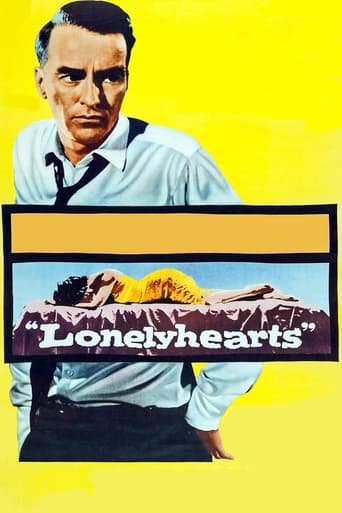
Corazones solitarios (1959)
Lonelyhearts
Con ganas de conseguir una posición periodística, Adam White se va a trabajar como columnista de un periódico que da consejos. Su editor, Shrike, se dedica a intimidar a su esposa alcohólica, Florence, por su pasado adultero. Y en asignar a sus empleados trabajos periodísticos para los cuales tienen poca aptitud o interés. Shrike incita a Adam a encontrarse con una de sus corresponsales, Fay Doyle, una mujer llorosa y auto compasiva ...
- Fecha de estreno
- 1959-03-04
- TMDB
- 6.3 / 10 (22)
- Duración
- 1 h 45 min
- Géneros
- Drama, Romance
- Director
- Vincent J. Donehue
Reparto
- Montgomery Clift — Adam White
- Robert Ryan — William Shrike
- Myrna Loy — Florence Shrike
- Dolores Hart — Justy Sargeant
- Maureen Stapleton — Fay Doyle
- Jackie Coogan — Ned Gates
- Mike Kellin — Frank Goldsmith
- Onslow Stevens — Mr. Lassiter
- Frank Maxwell — Pat Doyle
- Frank Overton — Mr. Sargeant
- John Gallaudet — Johnny
- Don Washbrook — Don Sargeant
Curiosidades
- Premios: 0 · Nominaciones: 1
Lonelyhearts, also known as Miss Lonelyhearts, is a 1958 American drama film directed by Vincent J. Donehue. It is based on the 1957 Broadway play by Howard Teichmann, which in turn is based on the 1933 novel Miss Lonelyhearts by Nathanael West.
Production
Dore Schary had been fired from head of production of MGM in 1956. He moved to New York and wrote the hit play Sunrise at Campobello. He then decided to return to filmmaking. He saw Miss Lonelyhearts, bought the rights, and set up the film at United Artists.
Director Vincent Donehue had worked on Sunrise. He had read the book and went to see the play Miss Lonelyhearts and "thought the novel was a very passionate, emotional and moral statement, and when I saw the Howard Teichmann play based on the novel I felt that its main difficulty lay in an alteration of the tone, which made it a very cerebral statement. The opinion coincided with Schary’s own views. He asked me to direct the film."
Schary wrote the script in collaboration with the director. There were two weeks of rehearsal prior to filming.
Myrna Loy said Montgomery Clift and Robert Ryan agreed to make the film at less than their usual fees because they admired the project. Loy agreed to make it because she believed in Schary who was a close friend. However "I questioned the attempt to film a movie in which the main character is actually a Christ figure. It could only be done as a bizarre sort of fantasy, which general audiences were not ready for in 1959.
Maureen Stapleton called the script "incredible - except for a ridiculous 'happy' ending."
Leer en Wikipedia · Texto de Wikipedia, CC BY-SA 4.0. Datos de Wikidata.
Recomendadas
- Tim 1979 · ★ 6.3
- Albatros: Una Historia de Amor 2011 · ★ 6.0
- La teoría del todo 2014 · ★ 7.8
- Love Story 1970 · ★ 6.8
- Persuasión 1995 · ★ 7.2
- Cosas pequeñas como estas 2024 · ★ 6.7
- Crimen perfecto 1954 · ★ 8.0
- ¿A quién ama Gilbert Grape? 1993 · ★ 7.7
- Amanecer 1927 · ★ 7.8
- Carta a tres esposas 1949 · ★ 7.2
- Lejos del cielo 2002 · ★ 7.1
- El cartero siempre llama dos veces 1946 · ★ 7.1