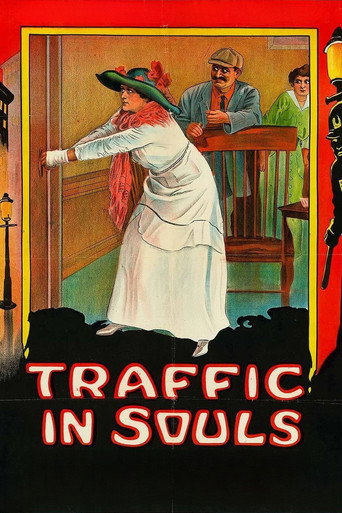
Traffic in Souls (1913)
A woman, with the aid of her police officer sweetheart, endeavors to uncover the prostitution ring that has kidnapped her sister, and the philanthropist who secretly runs it.
- Data de estreia
- 1913-11-24
- TMDB
- 5.0 / 10 (23)
- Duração
- 1 h 28 min
- Géneros
- Crime, Drama
- Realizador
- George Loane Tucker
Elenco
- Jane Gail — Mary Barton
- Ethel Grandin — Lorna Barton
- William H. Turner — Isaac Barton
- Matt Moore — Officer Larry Burke
- William Welsh — William Trubus
- Millie Liston — Mrs. Trubus
- Irene Wallace — Alice Trubus
- William Cavanaugh — Bill Bradshaw
- Howard Crampton — The go-between
- Arthur Hunter — Procurer
- W.H. Bainbridge — Mr. Smith
- Luray Huntley — Emigrant girl
Curiosidades
- Filmado em: Fort Lee e Nova Iorque
Traffic in Souls is a 1913 American silent crime drama film focusing on forced prostitution in the United States. Directed by George Loane Tucker and starring Jane Gail, Ethel Grandin, William H. Turner, and Matt Moore, Traffic in Souls is an early example of the narrative style in American films. The film consists of six reels, which was longer than most American films of the era.
Production
Traffic in Souls was based on a story by the film's director George Loane Tucker. The scenario was written by Walter MacNamara who also served as producer with Jack Cohn. Executive producers include King Baggot, Herbert Brenon, William Robert Daly, and Carl Laemmle.
The film was shot and produced by Universal Film Manufacturing Company in Fort Lee, New Jersey, where many early film studios in America's first motion picture industry were based at the beginning of the 20th century. Additional footage was shot on location at Ellis Island and Manhattan.
Terry Ramsaye, an early film historian, wrote in his book A Million and One Nights, that Traffic In Souls was made in under four weeks with a small budget of $5,000. He also claimed that all the money came from George Loane Tucker, Herbert Brenon, William Robert Daly, King Baggot, and Jack Cohn.
The film is notable for its pioneering use of camera movement while shooting scenes. Most films made prior to 1913 relied heavily on scenes shot head-on with a stationary camera. Some filmmakers had been moving, tilting or panning their cameras to track a moving object or follow action. For example, Harold M.
Ler na Wikipédia · Texto da Wikipédia, CC BY-SA 4.0. Dados do Wikidata.
Recomendados
- Sequestros Em Cleveland 2015 · ★ 7.3
- O Lobo atrás da Porta 2013 · ★ 7.2
- Òlòtūré 2019 · ★ 6.3
- Vice Squad 1982 · ★ 6.2
- O Protetor 1985 · ★ 5.9
- Foxy Brown - Uma Mulher e... Peras! 1974 · ★ 6.3
- Eu Sou Todas Elas 2021 · ★ 6.5
- As Noites de China Blue 1984 · ★ 6.2
- The Enforcer 2022 · ★ 7.0
- Wanda 1970 · ★ 6.8
- Resgate de Uma Vida 1971 · ★ 6.7
- O Cativeiro 2008 · ★ 5.9