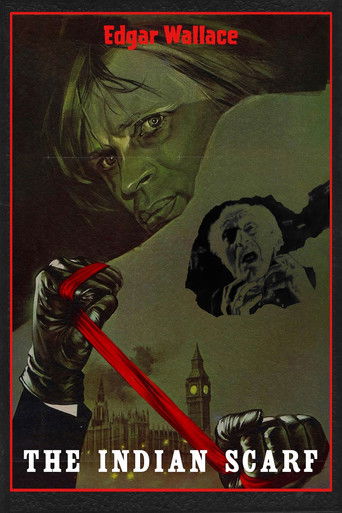
The Indian Scarf (1963)
Das indische Tuch
When a wealthy man dies, his avaricious relatives look forward to inheriting all his money. However, he leaves a provision in his will that they all must spend a week together in his castle before they will be able to inherit anything. At the castle (which is cut off from the outside world), the relatives soon begin to be killed off one by one, each strangled with an Indian scarf.
- Date of release
- 1963-09-13
- TMDB
- 6.8 / 10 (39)
- Runtime
- 1h 26m
- Genres
- Crime, Thriller
- Director
- Alfred Vohrer
Casting
- Heinz Drache — Frank Tanner
- Corny Collins — Isla Harris
- Klaus Kinski — Peter Ross
- Gisela Uhlen — Mrs. Tilling, geb. Lebanon
- Hans Nielsen — Mr. Tilling
- Siegfried Schürenberg — Sir Henry Hockbridge
- Hans Clarin — Lord Edward Lebanon
- Eddi Arent — Richard Maria Bonwit
- Ady Berber — Chiko
- Elisabeth Flickenschildt — Lady Emily Lebanon
- Richard Häussler — Dr. Amersham
- Alexander Engel — Reverend Hastings
Interesting facts
The Indian Scarf is a 1963 West German crime film directed by Alfred Vohrer. It was part of a very successful series of German films based on the writings of Edgar Wallace and adapted from the 1931 play The Case of the Frightened Lady.
Production
Das indische Tuch was part of a series of films based on works by Edgar Wallace made in the late 1950s and 1960s by producer Horst Wendlandt for Rialto Film. The script to the film was adapted first by Georg Hurdalek and then Harald G. Petersson from an original treatment by Egon Eis, written under the pen name of Trygve Larsen, that had not found the approval of the producer. At this stage, the film was to be called Der Unheimliche.
Heinz Drache was cast for this film after having starred as the hero of a very successful TV production of Francis Durbridge's The Scarf (Das Halstuch), which involved a similar modus operandi and was first aired in 1962. Several other actors, like Kinski, Arent and Schürenberg, had by that time become regulars in the film series.
The film was shot between 8 July and 13 August 1963 entirely in the Spandau Studios in West Berlin. There were no exterior shots at all. Wilhelm Vorwerk, who appears as Lord Lebanon, was not an actor, but rather the production designer at the Spandau studios. Eva Ebner was Vohrer's assistant.
The FSK gave the film a rating of 16 years and up and deemed it not appropriate for screenings on public holidays. It was released on 13 September 1963.
Read on Wikipedia · Text from Wikipedia, CC BY-SA 4.0. Data from Wikidata.
Recommended
- Frank and Penelope 2022 · ★ 7.3
- Panic 2000 · ★ 6.2
- Wardriver 2026 · ★ 7.5
- Awake 2007 · ★ 6.6
- The Calendar Killer 2024 · ★ 6.2
- Play Dead 2022 · ★ 6.1
- The Killer 2024 · ★ 6.3
- Killer Heat 2024 · ★ 5.8
- Suburbicon 2017 · ★ 5.9
- Underworld U.S.A. 1961 · ★ 7.1
- Fallen 1998 · ★ 6.8
- Cheat 2023 · ★ 7.1