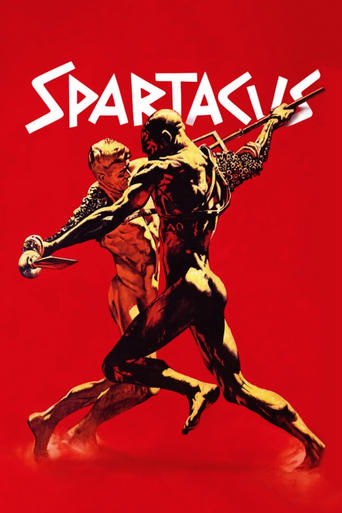
Spartacus (1960)
They trained him to kill for their pleasure ... but they trained him a little too well
The rebellious Thracian Spartacus, born and raised a slave, is sold to Gladiator trainer Batiatus. After weeks of being trained to kill for the arena, Spartacus turns on his owners and leads the other slaves in rebellion. As the rebels move from town to town, their numbers swell as escaped slaves join their ranks. Under the leadership of Spartacus, they make their way to southern Italy, where they will cross the sea and return to their homes.
- Date of release
- 1960-10-13
- TMDB
- 7.5 / 10 (2507)
- Runtime
- 3h 17m
- Genres
- History, Drama, Adventure
- Director
- Stanley Kubrick
Casting
- Kirk Douglas — Spartacus
- Laurence Olivier — Marcus Licinius Crassus
- Jean Simmons — Varinia
- Charles Laughton — Sempronius Gracchus
- Peter Ustinov — Lentulus Batiatus
- John Gavin — Julius Caesar
- Tony Curtis — Antoninus
- Nina Foch — Helena Glabrus
- John Ireland — Crixus
- Herbert Lom — Tigranes Levantus
- John Dall — Marcus Publius Glabrus
- Woody Strode — Draba
Interesting facts
- Budget: $12M
- Based on: Spartacus
- Filmed in: Madrid and Spain
- Awards: 5 · Nominations: 14. Including: Academy Award for Best Supporting Actor; Academy Award for Best Art Direction, Color; Academy Award for Best Costume Design, Color; Golden Globe Award for Best Motion Picture – Drama
Spartacus is a 1960 American epic historical drama film directed by Stanley Kubrick and starring Kirk Douglas as Spartacus, a slave and gladiator who leads a rebellion against Rome during the events of the Third Servile War. Adapted by Dalton Trumbo from Howard Fast's 1951 novel of the same title, the film also stars Laurence Olivier as Roman general and politician Marcus Licinius Crassus, Charles Laughton as rival senator Sempronius Gracchus, Peter Ustinov as gladiatorial school owner Lentulus Batiatus, and John Gavin as Julius Caesar. Jean Simmons played Spartacus' wife Varinia, a fictional character, and Tony Curtis played the fictional slave Antoninus.
Production
The development of Spartacus was partly instigated by Kirk Douglas' failure to win the title role in William Wyler's Ben-Hur (1959). Douglas had worked with Wyler before on Detective Story (1951), and was disappointed when Wyler chose Charlton Heston, instead.
Douglas's agent Lew Wasserman suggested he try having his film produced for Universal Studios. With Dalton Trumbo's screenplay being completed in two weeks, Universal and Douglas pulled ahead of Brynner's rival project. Brynner's project was later placed on hold as the weather conditions in Europe grew unsuitable for filming. Brynner then chose to film The Magnificent Seven (1960) instead.
Douglas originally offered the role of Varinia to French actress Jeanne Moreau, but she did not want to leave her boyfriend in France. German actress Sabine Bethmann was then cast. The studio gave her the anglicized name of "Sabina Bethman" for use in the film's publicity, but she was replaced by Jean Simmons after only two days of filming.
Howard Fast was initially hired to adapt his own novel into a screenplay. After 60 days had passed, Kirk Douglas read Fast's first draft, which he described as a "disaster, unusable." Pressed for time, and in competition with Brynner's rival project, Douglas turned to Dalton Trumbo, who had been blacklisted as one of the "Hollywood 10".
Douglas insisted that Trumbo be given screen credit for his work, which helped to break the blacklist. Trumbo had been jailed for contempt of Congress in 1950, after which he had survived by writing screenplays under assumed names. Douglas publicly announced that Trumbo was the screenwriter of Spartacus. Further, President John F. Kennedy publicly ignored a demonstration organized by the American Legion and went to see the film.
Read on Wikipedia · Text from Wikipedia, CC BY-SA 4.0. Data from Wikidata.
Recommended
- Barabbas 1961 · ★ 6.9
- Agora 2009 · ★ 7.0
- The Eagle 2011 · ★ 6.2
- The 300 Spartans 1962 · ★ 6.5
- The Way Back 2010 · ★ 7.0
- Kingdom of Heaven 2005 · ★ 7.1
- King Arthur 2004 · ★ 6.3
- Passage to Marseille 1944 · ★ 6.7
- Bilal: A New Breed of Hero 2016 · ★ 6.8
- Crouching Tiger, Hidden Dragon: Sword of Destiny 2016 · ★ 6.2
- The Count of Monte Cristo 2002 · ★ 7.7
- The Flame and the Arrow 1950 · ★ 6.4