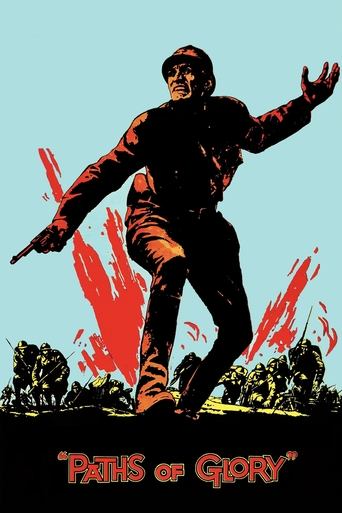
Paths of Glory (1957)
It explodes in the no-man's land no picture ever dared cross before!
A commanding officer defends three scapegoats on trial for a failed offensive that occurred within the French Army in 1916.
- Date of release
- 1957-10-25
- TMDB
- 8.3 / 10 (3439)
- Runtime
- 1h 28m
- Genres
- War, Drama
- Director
- Stanley Kubrick
Casting
- Kirk Douglas — Col. Dax
- Ralph Meeker — Cpl. Philippe Paris
- Adolphe Menjou — Gen. George Broulard
- George Macready — Gen. Paul Mireau
- Wayne Morris — Lt. Roget/Singing man
- Richard Anderson — Maj. Saint-Auban
- Joe Turkel — Pvt. Pierre Arnaud
- Christiane Kubrick — German Singer
- Jerry Hausner — Proprietor of Cafe
- Peter Capell — Narrator of Opening Sequence
- Emile Meyer — Father Dupree
- Bert Freed — Sgt. Boulanger
Interesting facts
- Budget: $935K
- Based on: Paths of Glory
- Filmed in: Schleißheim palace complex
Paths of Glory is a 1957 American anti-war film directed by Stanley Kubrick, from a screenplay he co-wrote with Calder Willingham and Jim Thompson. It is adapted from the 1935 novel of the same name by Humphrey Cobb, which in turn was based on the Souain corporals affair during World War I. The film stars Kirk Douglas as Colonel Dax, the commanding officer of French soldiers who refuse to continue a suicidal attack, after which Dax defends them against charges of cowardice in a court-martial. It also features Ralph Meeker, Adolphe Menjou, George Macready, Timothy Carey, Joe Turkel, Wayne Morris and Richard Anderson.
Production
The title of Cobb's novel came from the ninth stanza of Thomas Gray's poem "Elegy Written in a Country Churchyard" (1751).
The book was a minor success when published in 1935, retelling the true-life affair of four French soldiers who were executed to set an example to the rest of the troops. The novel was adapted to the stage the same year by Sidney Howard, World War I veteran and scriptwriter of Gone with the Wind. The play was a flop on Broadway because of its harsh anti-war scenes that alienated the audience.
Gray's stanza reflects Kubrick's feelings about war as well, and that becomes clear in the narrative of the film – a long battle for something with such an unimportant name as the "Ant Hill". Some of Kubrick's unrealized projects contained themes of war as well. Kubrick told the New York Times in 1972:
Man isn't a noble savage, he's an ignoble savage. He is irrational, brutal, weak, silly, unable to be objective about anything where his own interests are involved – that about sums it up. I'm interested in the brutal and violent nature of man because it's a true picture of him. And any attempt to create social institutions on a false view of the nature of man is probably doomed to failure.
Paths of Glory is based loosely on the true story of the Souain corporals affair when four French soldiers were executed in 1915 during World War I under General Géraud Réveilhac for failure to follow orders. The soldiers were exonerated posthumously in 1934. The novel is about the French execution of innocent men to strengthen others' resolve to fight.
Read on Wikipedia · Text from Wikipedia, CC BY-SA 4.0. Data from Wikidata.
Recommended
- The Longest Day 1962 · ★ 7.6
- The War Below 2021 · ★ 6.6
- The Lost Battalion 2001 · ★ 6.7
- The Zone of Interest 2023 · ★ 7.0
- The One That Got Away 1957 · ★ 6.8
- Journey's End 2017 · ★ 6.3
- The Last Rifleman 2023 · ★ 6.6
- Bonhoeffer: Pastor. Spy. Assassin 2024 · ★ 6.8
- The Guns of Navarone 1961 · ★ 7.3
- The Young Lions 1958 · ★ 6.7
- The Birth of a Nation 1915 · ★ 5.9
- Hitler: The Last Ten Days 1973 · ★ 6.2