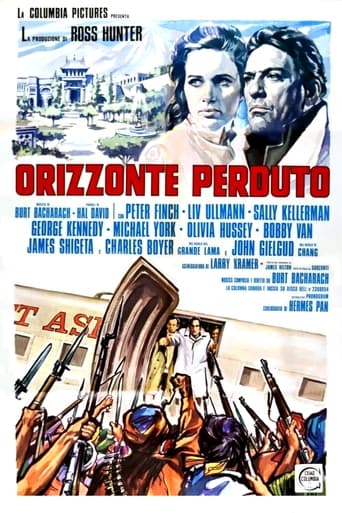
Orizzonte perduto (1973)
Lost Horizon
Costretti ad abbandonare un paese del sud-est asiatico nel quale infuria la rivoluzione, il diplomatico inglese Richard Conway, suo fratello George ed altri cittadini occidentali prendono posto su un aereo che dovrebbe condurli verso la salvezza. L'aereo viene però dirottato e termina il volo con un atterraggio di fortuna sui monti dell'Himalaya. I viaggiatori sono salvi, ma sarebbero decimati dal freddo e dalla fame se non venissero soccorsi da una carovana di tibetani. Sotto la loro guida, Conway e i suoi compagni raggiungono la leggendaria Shangri-la, una fertile valle miracolosamente riparata dalle intemperie dove il tempo trascorre lento e sereno, lontano dall'egoismo e dalla violenza degli uomini. Affascinato dalla filosofia di vita che ispira la piccola, felice comunità a progredire nel bene e nella pace, Conway apprende di essere stato prescelto come successore del Grande Lama, il saggio ultracentenario che ha fondato e governato finora la città.
- Data di uscita
- 1973-03-14
- TMDB
- 5.4 / 10 (41)
- Durata
- 2 h 30 min
- Generi
- Avventura, Dramma, Fantasy, Musica, Romance
- Regista
- Charles Jarrott
Cast
- Peter Finch — Richard Conway
- Liv Ullmann — Catherine
- Sally Kellerman — Sally Hughes
- George Kennedy — Sam Cornelius
- Michael York — George Conway
- Olivia Hussey — Maria
- Bobby Van — Harry Lovett
- James Shigeta — Brother To-Lenn
- Charles Boyer — The High Lama
- John Gielgud — Chang
- Kent Smith — Bill Fergunson
- John van Dreelen — Dr. Verden
Curiosità
- Basato su: Orizzonte perduto
Lost Horizon is a 1973 musical fantasy adventure drama film directed by Charles Jarrott and starring Peter Finch, Liv Ullmann, Sally Kellerman, George Kennedy, Michael York, Olivia Hussey, Bobby Van, James Shigeta, Charles Boyer and John Gielgud. It was also the final film produced by Ross Hunter. The film is a remake of Frank Capra's 1937 film of the same name, with a screenplay by Larry Kramer. Both stories were adapted from James Hilton's 1933 novel Lost Horizon.
Production
Ross Hunter made his name producing remakes at Universal, including Magnificent Obsession and Imitation of Life. Lost Horizon had previously been adapted onstage as Shangri-La in 1956.
In April 1971, after 20 years of association, Hunter departed Universal and set up operations at Columbia where his first film was to be Lost Horizon. In 1971, Hunter said, Burt Bacharach and I have been talking about doing a picture together for years. But Burt's been saying 'I've made so much money that when I do a movie I want it to last. Then maybe my movie will last.
Hunter called the film "a picture of hope, of faith with a spiritual quality. We all need that with the pressures of the world... Everyone's looking for a place that has peace and security." Hunter had a role written for Helen Hayes. Julie Andrews was considered for the role of Catherine.
In December 1971, Charles Jarrott signed to direct, with Peter Finch cast in February 1972. March 1972 saw the hiring of Hermes Pan as choreographer.
Finch later stated that he enjoyed his time on the film.
Leggi su Wikipedia · Testo da Wikipedia, CC BY-SA 4.0. Dati da Wikidata.
Consigliati
- The Cave - Acqua alla gola 2019 · ★ 6.0
- Il filo del rasoio 1984 · ★ 6.4
- Darkest Minds 2018 · ★ 7.0
- Cinderella 1965 · ★ 6.5
- Storia d'inverno 2014 · ★ 6.3
- Sahara 1983 · ★ 5.9
- Everest 2015 · ★ 6.8
- Ogni tuo respiro 2017 · ★ 7.4
- The Aeronauts 2019 · ★ 6.8
- Sette anni in Tibet 1997 · ★ 7.2
- Un amore senza fine 2014 · ★ 6.9
- L'abbazia di Northanger 2007 · ★ 6.8