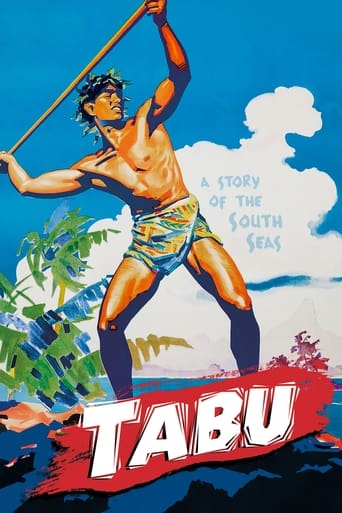
Tabu: A Story of the South Seas (1931)
On the South Pacific island of Bora Bora, a young couple's love is threatened when the tribal chief declares the girl a sacred virgin.
- Data lansării
- 1931-07-30
- TMDB
- 7.1 / 10 (193)
- Durată
- 1 h 26 min
- Genuri
- Romantic, Dramă, Aventuri
- Regizor
- F. W. Murnau
Distribuție
- Matahi — The Boy
- Anne Chevalier — The Girl (as Reri)
- Bill Bambridge — The Policeman (as Jean)
- Hitu — The Old Warrior
- Jules — The Captain (uncredited)
Curiozități
- Încasări: 472 K USD
- Buget: 150 K USD
- A încasat de 3,1× bugetul
- Filmat în: Tahiti
- Premii: 2 · Nominalizări: 1. Inclusiv: Premiul Oscar pentru cea mai bună imagine; National Board of Review: Top Ten Films
Tabu: A Story of the South Seas is a 1931 American synchronized sound film directed by F. W. Murnau. While the film has no audible dialog, it was released with a synchronized musical score with sound effects using the Western Electric Sound System sound-on-film process. A docufiction, it is split into two chapters: The first, called "Paradise", depicts the lives of two lovers on a South Seas island until they are forced to escape the island when the girl is chosen as a holy maid to the gods. The second chapter, "Paradise Lost", depicts the couple's life on a colonised island and how they adapt to and are exploited by Western civilisation.
Production
Murnau was coming off two troubled Fox Studios productions, Four Devils (1928) and City Girl (1930), while Flaherty's Native American documentary Acoma the Sky City had been shut down. The two directors knew each other through Flaherty's brother David, and Murnau expressed a desire to make a film in Tahiti with Flaherty who had experience with the natives there.
Murnau visited Tahiti in May 1929 and was joined by Flaherty a month later to scout for locations on the nearby island of Bora Bora. While scouting, they found their leading lady, Anne Chevalier, in a local cocktail bar.
The production was originally supposed to be financed by a small production company called Colorart. By September, however, Murnau had only received $5,000 of the due money. After a series of telegrams asking for the rest of the money, Murnau got fed up and decided to fund it himself.
To cut costs, Murnau sent the Hollywood crew home and trained the natives to work as the crew. He also scrapped plans to shoot the film in colour and changed to black and white. The film's script was rewritten and the title was changed to Tabu: A Story of the South Seas to avoid potential legal issues with Colorart. This was the start of a poor working relationship between Flaherty and Murnau.
Production began in January 1930, with Flaherty directing the opening scene of the film. This would be the only scene he directed. Flaherty began having technical problems, as his camera was causing the film to rip. He called in cinematographer Floyd Crosby for help and the rest of the film was shot by Crosby.
Citește pe Wikipedia · Text din Wikipedia, CC BY-SA 4.0. Date din Wikidata.
Recomandate
- Naufragiatul 2000 · ★ 7.7
- Acasă, în Hawaii 2000 · ★ 6.3
- Supraviețuind pe mare 2018 · ★ 6.8
- Ultimul cântec 2010 · ★ 7.2
- The Journey of Natty Gann 1985 · ★ 6.8
- Nobody Has to Know 2022 · ★ 6.7
- Robinson Crusoe 1997 · ★ 6.0
- Aventura lui Poseidon 1972 · ★ 7.2
- Seceră vântul sălbatic 1942 · ★ 6.3
- Toamna la New York 2000 · ★ 6.1
- Întoarcerea la laguna albastră 1991 · ★ 6.2
- King Kong 2005 · ★ 6.9