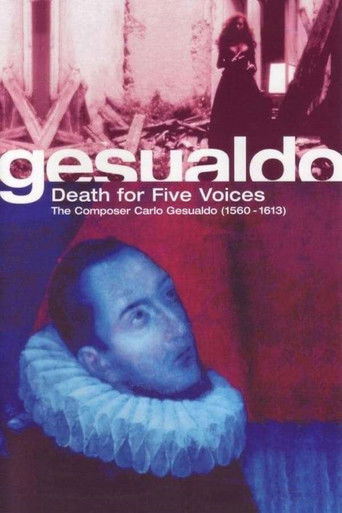
Gesualdo : Mort à cinq voix (1995)
Tod für fünf Stimmen
La vie et l'œuvre de Carlo Gesualdo (1560-1613). Ce compositeur surdoué apparait dans les chroniques napolitaines lors du meurtre de sa première femme et de son amant.
- Date de sortie
- 1995-06-06
- TMDB
- 6.8 / 10 (16)
- Durée
- 59 min
- Genres
- Documentaire, Téléfilm, Musique, Histoire
- Réalisateur
- Werner Herzog
Distribution
- Milva — Herself
- Alan Curtis — Himself
- Werner Herzog — Narrator (voice)
- Walter Beloch — Himself
- Angelo Carrabs — Himself
- Francesco D'Avalos — Himself
- Salvatore Catorano — Himself
- Vincenzo Giusto — Himself
- Giovanni Iudica — Himself
- Alberto Lanini — Himself
- Antonio Massa — Himself
- Gennaro Miccio — Himself
Anecdotes
Gesualdo: Death for Five Voices is a 1995 film by German director Werner Herzog filmed for ZDF television. The film explores the music of Carlo Gesualdo and the legends surrounding Gesualdo's personality, his cursed castle, and his murder of his wife and her lover. Between narration and interviews, several of Gesualdo's madrigals are performed. Herzog calls Death for Five Voices "one of the films closest to my heart."
Production
Much of the film was shot in the town of Gesualdo in and around the site of Carlo Gesualdo's ruined castle. Other scenes were filmed in Venosa (the composer's attributed birthplace), Cortona, Arezzo and Naples.
The film contains many scenes which are not documentary in the traditional sense. Herzog says:
"Most of the stories in the film are completely invented and staged, yet they contain the most profound possible truths about Gesualdo. I think of all my 'documentaries', Death for Five Voices is the one that really runs amok, and it is one of the films closest to my heart."
The woman claiming to be the ghost of d'Avalos was played by famous Italian actress and singer Milva. The scene of a museum curator discussing an artifact which perplexed Gesualdo was scripted by Herzog. In fact the artifact shown in the film had puzzled Herzog himself and caused him to lose sleep, yet had no connection to Gesualdo.
The final scene of a renaissance fair performer talking with his mother on a cell phone was also staged. Herzog instructed his brother, standing just off-camera, to call the young man and for the man to act like his mother was asking him to come home. The young man was then instructed to stare seriously into the camera, and this footage was used during the end credits.
Lire sur Wikipédia · Texte de Wikipédia, CC BY-SA 4.0. Données de Wikidata.
Recommandés
- John & Yoko 2018 · ★ 7.1
- Justin Bieber's Believe 2013 · ★ 6.9
- I Called Him Morgan 2016 · ★ 7.0
- The Boys: l'histoire des frères Sherman 2009 · ★ 7.2
- Something from Nothing: The Art of Rap 2012 · ★ 6.6
- Rolling Thunder Revue : A Bob Dylan Story by Martin Scorsese 2019 · ★ 7.0
- Whitney 2018 · ★ 7.3
- Biggie: I Got a Story to Tell 2021 · ★ 7.1
- Adele - One Night Only 2021 · ★ 7.7
- Shawn Mendes : In Wonder 2020 · ★ 8.1
- Jennifer Lopez : Halftime 2022 · ★ 6.8
- Ramones - End of the Century 2003 · ★ 7.6