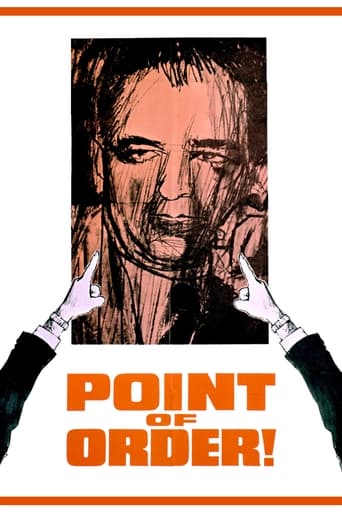
Les derniers jours du sénateur McCarthy (1964)
Point of Order!
Toute la carrière politique de celui qui allait donner son nom au « mccarthysme » n’aura duré que quatre ans, du 9 février 1950 au 2 décembre 1954. La première date est celle du jour où il prononce son célèbre discours et la seconde, celle de la censure du Sénat qui, par 67 voix contre 22, met fin à sa carrière politique. En mars 53, une émission de CBS attaque McCarthy. Pour la première fois, les caméras de la télévision pénétrèrent au cœur du Sénat, et retransmirent ces auditions, en direct, huit heures par jour, et en firent le plus grand spectacle politique de l’histoire des Etats-Unis. De ces cent 87 heures, le réalisateur Emile de Antonio en a tiré un film, « Point of Order », qui raconte la chute de McCarthy. Notre film est une adaptation du document de Emile de Antonio, pour une audience d’aujourd’hui en rappelant brièvement la carrière du sénateur et le contexte de la guerre froide.
- Date de sortie
- 1964-01-14
- TMDB
- 6.4 / 10 (11)
- Durée
- 52 min
- Genres
- Documentaire
- Réalisateur
- Emile de Antonio
Distribution
- Joseph McCarthy — Self
- Roy Cohn — Self
- Karl E. Mundt — Self
- Joseph N. Welch — Self
- Stuart Symington — Self
- Scoop Jackson — Self
- John L. McClellan — Self
- G. David Schine — Self
Anecdotes
Point of Order! is a 1963 American documentary film by Emile de Antonio about the Senate Army–McCarthy hearings of 1954.
Production
Point of Order! was first imagined by Emile de Antonio and Daniel Talbot in 1961. De Antonio and Talbot thought a film about the Army–McCarthy hearings could be successful at Henry Rosenberg's New Yorker Theater. De Antonio persuaded Richard Ellison at CBS to help him find footage of the Army–McCarthy Hearings; Ellison informed de Antonio that the network held a complete set of kinescopes for the hearings.
De Antonio hired a young editor named Robert Duncan to help edit the film. Their plan was to remove any narration, music, or added scenes and create a documentary using only the footage from the kinescopes of the hearings. This approach to filmmaking—which de Antonio would use on later films—was similar to the use of assemblage in the works of modern artists like Robert Rauschenberg, who was a friend of de Antonio.
Lire sur Wikipédia · Texte de Wikipédia, CC BY-SA 4.0. Données de Wikidata.
Recommandés
- Directed by John Ford 1971 · ★ 7.0
- Champs 2015 · ★ 6.4
- Halloween : 25 Years of Terror 2006 · ★ 6.8
- Woman 2020 · ★ 7.7
- Downloaded 2013 · ★ 6.5
- Amour et Machinations 2026 · ★ 6.5
- Naqoyqatsi 2002 · ★ 6.2
- Birth of the Living Dead 2013 · ★ 6.7
- The Class of ‘92 2013 · ★ 7.1
- S4: The Bob Lazar Story 2026 · ★ 8.4
- Fuck 2006 · ★ 6.4
- The Curious Birth of Benjamin Button 2009 · ★ 7.0