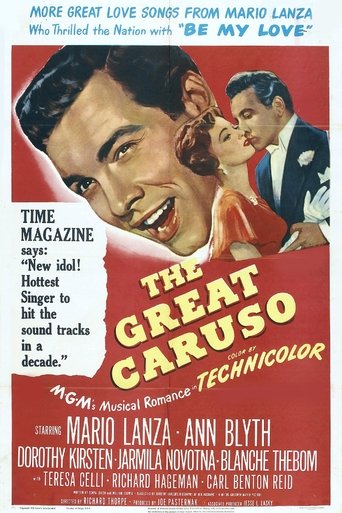
The Great Caruso (1951)
The Intimate Story of a Man with a Voice as Great as His Heart!
Enrico Caruso's only passion is to sing. For that, he leaves his hometown of Naples, Italy, and travels to America to sing for the Metropolitan Opera. At first, his lack of education and poor background make him an outcast in the high-class opera world. Eventually, his voice wins him both fans and the hand of his love, Dorothy. But his nonstop pace and desire to perform at any cost eventually take their toll on the singer's health.
- Date of release
- 1951-04-16
- TMDB
- 5.9 / 10 (20)
- Runtime
- 1h 49m
- Genres
- Drama, Music
- Director
- Richard Thorpe
Casting
- Mario Lanza — Enrico Caruso
- Ann Blyth — Dorothy Benjamin
- Dorothy Kirsten — Louise Heggar
- Jarmila Novotná — Maria Selka
- Richard Hageman — Carlo Santi
- Carl Benton Reid — Park Benjamin
- Eduard Franz — Giulio Gatti-Casazza
- Ludwig Donath — Alfredo Brazzi
- Alan Napier — Jean de Reszke
- Blanche Thebom — Vocalist - Opera Montage
- Teresa Celli — Vocalist - Opera Montage
- Nicola Moscona — Vocalist - Opera Montage
Interesting facts
- Awards: 1 · Nominations: 3. Including: Academy Award for Best Sound
The Great Caruso is a 1951 biographical film directed by Richard Thorpe, produced by Joe Pasternak, distributed by Metro-Goldwyn-Mayer and starring Mario Lanza as operatic tenor Enrico Caruso. The highly fictionalized screenplay, written by Sonya Levien and William Ludwig, is based on the biography Enrico Caruso His Life and Death by Dorothy Caruso, Caruso's widow. The original music was composed and arranged by Johnny Green, the cinematographer was Joseph Ruttenberg and the costume designers were Helen Rose and Gile Steele.
Production
Peter Herman Adler was hired as a technical advisor for the film and served as voice coach for Mario Lanza. Adler also supervised the recording of the film's music.
Although The Great Caruso follows most of the basic facts of Caruso's life, several of the characters and incidents are fictional. Because of this, the Caruso family in Italy successfully sued MGM for monetary damages, and the studio was temporarily ordered to withdraw the film from exhibition in Italy. The factual discrepancies include:
A montage shows the rise of the young Caruso from operatic chorister to singing the secondary tenor role of Spoletta in Puccini's opera Tosca. Caruso never sang in an opera chorus, nor did he ever appear in a supporting role. When Tosca premiered in 1900, Caruso was already a rising opera star and had been considered by Puccini himself for the lead tenor role of Cavaradossi, though the part was given to another tenor, Emilio de Marchi.
In the film, Caruso makes his American debut at the Metropolitan Opera in Verdi's Aida and is met with silence from the audience and scathing critical reviews. In reality, Caruso's Met debut in Rigoletto was well-received and he became an immediate favorite with New York audiences and critics.
Opera impresario Giulio Gatti-Casazza is depicted as the general manager of the Metropolitan Opera at the time of Caruso's debut there in 1903. In reality, Gatti-Casazza did not arrive at the Met until 1908, five years after Caruso's debut.
Read on Wikipedia · Text from Wikipedia, CC BY-SA 4.0. Data from Wikidata.
Recommended
- Springsteen: Deliver Me from Nowhere 2025 · ★ 6.6
- Coda 2020 · ★ 6.1
- Grace Unplugged 2013 · ★ 6.0
- Respect 2021 · ★ 6.8
- Maria 2024 · ★ 6.5
- Thirty Two Short Films About Glenn Gould 1993 · ★ 7.0
- Teen Spirit 2019 · ★ 6.0
- My Dinner with Hervé 2018 · ★ 6.3
- Selena 1997 · ★ 7.7
- The Tales of Hoffmann 1951 · ★ 7.1
- Eleanor the Great 2025 · ★ 6.8
- TÁR 2022 · ★ 7.1