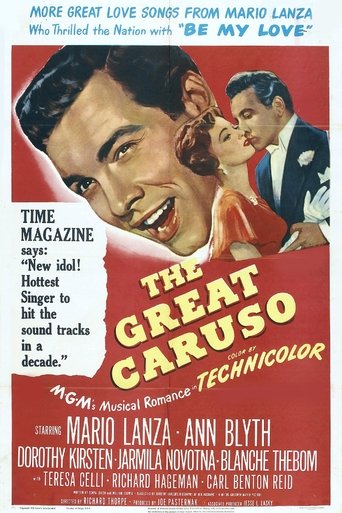
伟大的卡鲁索 (1951)
The Great Caruso
恩里科-卡鲁索唯一的爱好就是唱歌。为此,他离开家乡意大利那不勒斯,前往美国为大都会歌剧院演唱。起初,由于缺乏教育和出身贫寒,他在高级歌剧世界中被排斥在外。最终,他的歌声为他赢得了歌迷和爱人桃乐茜的芳心。但他不停歇的节奏和不惜一切代价的表演欲望最终损害了这位歌手的健康。
- 上映日期
- 1951-04-16
- TMDB
- 5.9 / 10 (20)
- 片长(分钟)
- 1小时49分钟
- 类型
- 剧情, 音乐
- 导演
- Richard Thorpe
演员阵容
- Mario Lanza — Enrico Caruso
- 安·布莱思 — Dorothy Benjamin
- Dorothy Kirsten — Louise Heggar
- Jarmila Novotná — Maria Selka
- Richard Hageman — Carlo Santi
- Carl Benton Reid — Park Benjamin
- Eduard Franz — Giulio Gatti-Casazza
- Ludwig Donath — Alfredo Brazzi
- 艾伦·纳皮尔 — Jean de Reszke
- Blanche Thebom — Vocalist - Opera Montage
- Teresa Celli — Vocalist - Opera Montage
- Nicola Moscona — Vocalist - Opera Montage
趣闻
- 获奖:1 · 提名:3. 包括:奧斯卡最佳混音獎
The Great Caruso is a 1951 biographical film directed by Richard Thorpe, produced by Joe Pasternak, distributed by Metro-Goldwyn-Mayer and starring Mario Lanza as operatic tenor Enrico Caruso. The highly fictionalized screenplay, written by Sonya Levien and William Ludwig, is based on the biography Enrico Caruso His Life and Death by Dorothy Caruso, Caruso's widow. The original music was composed and arranged by Johnny Green, the cinematographer was Joseph Ruttenberg and the costume designers were Helen Rose and Gile Steele.
Production
Peter Herman Adler was hired as a technical advisor for the film and served as voice coach for Mario Lanza. Adler also supervised the recording of the film's music.
Although The Great Caruso follows most of the basic facts of Caruso's life, several of the characters and incidents are fictional. Because of this, the Caruso family in Italy successfully sued MGM for monetary damages, and the studio was temporarily ordered to withdraw the film from exhibition in Italy. The factual discrepancies include:
A montage shows the rise of the young Caruso from operatic chorister to singing the secondary tenor role of Spoletta in Puccini's opera Tosca. Caruso never sang in an opera chorus, nor did he ever appear in a supporting role. When Tosca premiered in 1900, Caruso was already a rising opera star and had been considered by Puccini himself for the lead tenor role of Cavaradossi, though the part was given to another tenor, Emilio de Marchi.
In the film, Caruso makes his American debut at the Metropolitan Opera in Verdi's Aida and is met with silence from the audience and scathing critical reviews. In reality, Caruso's Met debut in Rigoletto was well-received and he became an immediate favorite with New York audiences and critics.
Opera impresario Giulio Gatti-Casazza is depicted as the general manager of the Metropolitan Opera at the time of Caruso's debut there in 1903. In reality, Gatti-Casazza did not arrive at the Met until 1908, five years after Caruso's debut.
在维基百科阅读更多 · 文本来自维基百科,CC BY-SA 4.0。数据来自 Wikidata。