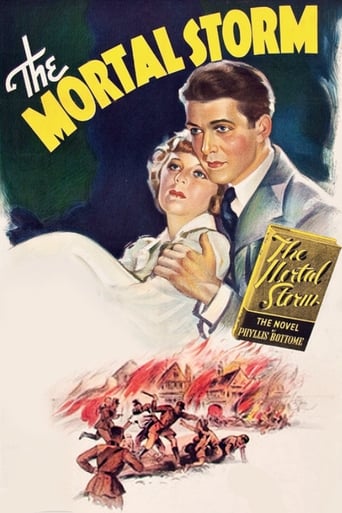
The Mortal Storm (1940)
The Most Exciting Picture!
The Roth family leads a quiet life in a small village in the German Alps during the early 1930s. After the Nazis come to power, the family is divided and Martin Breitner, a family friend, is caught up in the turmoil.
- Date of release
- 1940-06-20
- TMDB
- 7.4 / 10 (103)
- Runtime
- 1h 40m
- Genres
- Drama
- Director
- Frank Borzage
Casting
- Margaret Sullavan — Freya Roth
- James Stewart — Martin Breitner
- Robert Young — Fritz Marberg
- Frank Morgan — Professor Victor Roth
- Robert Stack — Otto Von Rohn
- Bonita Granville — Elsa
- Irene Rich — Mrs. Roth
- William T. Orr — Erich Von Rohn
- Maria Ouspenskaya — Mrs. Breitner
- Gene Reynolds — Rudi
- Russell Hicks — Rector
- William Edmunds — Lehman
Interesting facts
The Mortal Storm is a 1940 American drama film produced by Metro-Goldwyn-Mayer. It was directed by Frank Borzage and stars Margaret Sullavan and James Stewart. The film shows the impact on Germans after Hitler becomes chancellor of Germany and gains unlimited power. The supporting cast features Robert Young, Robert Stack, Frank Morgan, Dan Dailey, Ward Bond and Maria Ouspenskaya.
Production
The film is based on the 1937 novel The Mortal Storm by the British writer Phyllis Bottome, who had moved to Austria in 1924 when her husband Alban Ernan Forbes Dennis was posted there. Dennis was a British diplomat and an MI6 station head with responsibility for Austria, Hungary and Yugoslavia. In 1930, she moved to Munich. She witnessed the rise of fascism, the rise to power of the Nazi party and the transformation of Nazi Germany.
The film's script diverged considerably from the story told in the book, but Bottome felt that the film retained the book's essence. However, Bottome wrote: "What it is to be a Nazi has been shown with unequivocal sincerity and life-likeness, but in the scene between the Jewish professor and his son, Rudi, there was a watering down of courage.
The Mortal Storm was the only MGM movie to explicitly criticize the Nazi regime before America’s entry into World War II in December 1941. The film, however, made only oblique references to its antisemitic policies.
The Freya Roth character is the daughter of a Junker mother and a "non-Aryan" father. It is implied that Freya, her father and Rudi are Jews, but the word "Jew" is never actually used, and they are identified as "non-Aryans." However, in the scene where professor Roth is visited by his wife in the concentration camp, the sleeves of his shirt bear the large letter J (possibly to represent the yellow Star of David that Jews were forced by the Nazis…
Metro-Goldwyn-Mayer movie mogul Louis B. Mayer, was aware that Warner Bros. studio pictures had been banned in Germany after their release of the anti-Hitler Confessions of a Nazi Spy (1939). Mayer was loath to lose the lucrative German market. As such, MGM films were presented to the Nazi German consul for approval, and objectionable scenes were modified before the film’s release in Germany.
Read on Wikipedia · Text from Wikipedia, CC BY-SA 4.0. Data from Wikidata.
Recommended
- Hitler: The Last Ten Days 1973 · ★ 6.2
- The Devil's Arithmetic 1999 · ★ 6.8
- Bonhoeffer: Pastor. Spy. Assassin 2024 · ★ 6.7
- Holy Lands 2019 · ★ 6.1
- The Zone of Interest 2023 · ★ 7.0
- The House on Carroll Street 1988 · ★ 5.9
- The Dead 1987 · ★ 6.9
- Won't Back Down 2012 · ★ 6.2
- The Pelican Brief 1993 · ★ 6.6
- Who's Afraid of Virginia Woolf? 1966 · ★ 7.7
- Remember 2015 · ★ 7.3
- Detachment 2011 · ★ 7.6