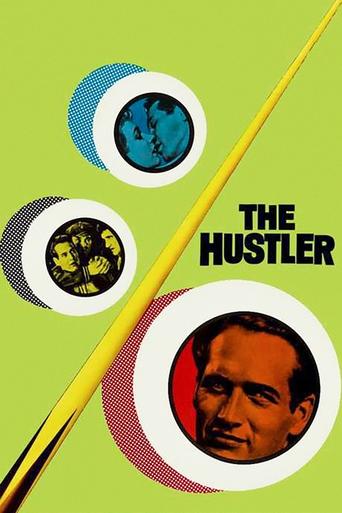
The Hustler (1961)
They called him Fast Eddie. He was a winner. He was a loser. He was a hustler.
Fast Eddie Felson is a small-time pool hustler with a lot of talent but a self-destructive attitude. His bravado causes him to challenge the legendary Minnesota Fats to a high-stakes match.
- Date of release
- 1961-09-25
- TMDB
- 7.7 / 10 (1141)
- Runtime
- 2h 15m
- Genres
- Drama, Romance
- Director
- Robert Rossen
- Collection
- The Hustler Collection
Casting
- Paul Newman — Eddie Felson
- Jackie Gleason — Minnesota Fats
- Piper Laurie — Sarah Packard
- George C. Scott — Bert Gordon
- Myron McCormick — Charlie Burns
- Murray Hamilton — Findley
- Michael Constantine — Big John
- Stefan Gierasch — Preacher
- Clifford A. Pellow — Turk
- Jake LaMotta — Bartender
- Gordon B. Clarke — Cashier
- Alexander Rose — Score Keeper
Interesting facts
- Box office: $7.6M
- Budget: $2.1M
- Earned 3.6× its budget
- Based on: The Hustler
- Filmed in: New York City
- Awards: 4 · Nominations: 14. Including: Academy Award for Best Cinematography, Black-and-White; Academy Award for Best Art Direction, Black and White; BAFTA Award for Best Film; National Board of Review: Top Ten Films
The Hustler is a 1961 American sports drama film, directed by Robert Rossen. It tells the story of small-time pool hustler "Fast Eddie" Felson, who challenges legendary pool player "Minnesota Fats".
Production
The Tevis novel had been optioned several times, including by Frank Sinatra, but attempts to adapt it for the screen were unsuccessful. Director Rossen's daughter Carol Rossen speculates that previous adaptations focused too much on the pool aspects of the story and not enough on the human interaction.
According to Bobby Darin's agent, Martin Baum, Paul Newman's agent turned down the part of Fast Eddie. Newman was originally unavailable to play Fast Eddie regardless, being committed to star opposite Elizabeth Taylor in the film Two for the Seesaw. Rossen offered Darin the part after seeing him on The Mike Wallace Interview.
Rossen filmed The Hustler over six weeks, entirely in New York City. Much of the action was filmed at two now-defunct pool halls, McGirr's and Ames Billiard Academy. Other shooting locations included a townhouse on East 82nd Street, which served as the Louisville home of Murray Hamilton's character Findley, and the Manhattan Greyhound bus terminal.
Early shooting put more focus on the pool playing, but during filming Rossen made the decision to place more emphasis on the love story between Newman and Laurie's characters. Despite the change in emphasis, Rossen still used the various pool games to show the strengthening of Eddie's character and the evolution of his relationship to Bert and Sarah, through the positioning of the characters in the frame.
Read on Wikipedia · Text from Wikipedia, CC BY-SA 4.0. Data from Wikidata.
Recommended
- Dinner Rush 2000 · ★ 7.0
- Nightmare Alley 1947 · ★ 7.2
- Croupier 1998 · ★ 6.7
- Atlantic City 1980 · ★ 6.8
- 21 2008 · ★ 6.7
- The Great Gatsby 1974 · ★ 6.3
- Owning Mahowny 2003 · ★ 6.8
- Citizen Kane 1941 · ★ 8.0
- Requiem for a Heavyweight 1962 · ★ 7.2
- Cassandra's Dream 2007 · ★ 6.3
- Stealing Home 1988 · ★ 6.3
- The Way Back 2020 · ★ 6.6