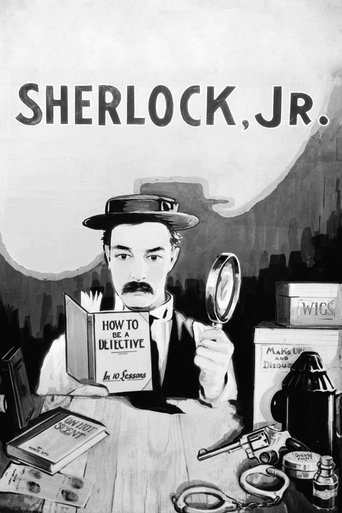
Sherlock Jr. (1924)
Every inch of footage holds such a laugh!
A film projectionist longs to be a detective, and puts his meager skills to work when he is framed by a rival for stealing his girlfriend's father's pocketwatch.
- Date of release
- 1924-04-17
- TMDB
- 8.0 / 10 (1243)
- Runtime
- 45m
- Genres
- Action, Comedy, Mystery
- Director
- Buster Keaton
Casting
- Buster Keaton — Projectionist / Sherlock, Jr.
- Kathryn McGuire — The Girl
- Joe Keaton — The Girl's Father / Man on Film Screen
- Erwin Connelly — The Hired Man / The Butler
- Ward Crane — The Local Sheik / The Villain
- Doris Deane — Girl Who Loses Dollar Outside Cinema (uncredited)
- Christine Francis — Candy Store Girl (uncredited)
- George Davis — Conspirator (uncredited)
- Kewpie Morgan — Conspirator (uncredited)
- Steve Murphy — Conspirator (uncredited)
- John Patrick — Conspirator (uncredited)
- Betsy Ann Hisle — Little Girl (uncredited)
Interesting facts
- Box office: $448.3K
Sherlock Jr. is a 1924 American silent comedy film directed by and starring Buster Keaton and written by Clyde Bruckman, Jean Havez, and Joseph A. Mitchell. It features Kathryn McGuire, Joe Keaton, and Ward Crane.
Production
Originally titled The Misfit, production began in January 1924 in Los Angeles. Keaton later said that his character walking onto the screen and into a film was "the reason for making the whole picture ... Just that one situation." Having cast her in Three Ages, Keaton cast Marion Harlan as the lead actress, but she became sick and was replaced by up-and-coming Keystone Studios actress Kathryn McGuire, who had previously starred in The Silent Call…
Keaton initially hired Roscoe "Fatty" Arbuckle as his co-director for the film. Keaton had been discovered by Arbuckle, whose career was at a standstill after being accused of raping Virginia Rappe in 1921. During the scandal and court case, Arbuckle had lost his mansion and cars and was in debt for $750,000. Keaton wanted to help his old friend and hired Arbuckle under the pseudonym "William Goodrich".
Arbuckle became angry and abusive on set, yelling at actors and according to Keaton becoming "flushed and mad ... [the scandal] just changed his disposition." In his autobiography, Keaton claimed that Arbuckle was difficult to work with and he arranged for him to direct The Red Mill instead so that Keaton could complete the film alone. The Red Mill did not begin production until 1927.
The production included one of Keaton's most famous on-set accidents. In a scene where Keaton grabs a water spout while walking on a moving boxcar train, the water unexpectedly flooded down on Keaton much harder than anticipated, throwing him to the ground. The back of Keaton's neck slammed against a steel rail on the ground and caused him to black out.
It was not until 1935 that a doctor spotted a callus over a fracture in Keaton's top vertebra in an X-ray. The doctor informed Keaton that he had broken his neck during the accident nine years earlier and not realized it. Keaton famously always performed his own stunts, and this was not the only accident on set.
Read on Wikipedia · Text from Wikipedia, CC BY-SA 4.0. Data from Wikidata.
Recommended
- Nothing to Lose 1997 · ★ 6.6
- The Late Show 1977 · ★ 6.3
- Who's Harry Crumb? 1989 · ★ 5.9
- WHAT DID JACK DO? 2017 · ★ 6.3
- Wild Hogs 2007 · ★ 6.0
- Scooby-Doo 2002 · ★ 6.1
- The Naked Gun 2025 · ★ 6.3
- The Cheap Detective 1978 · ★ 6.4
- How to Rob a Bank 2007 · ★ 5.8
- The Return of the Pink Panther 1975 · ★ 6.8
- The Laurel-Hardy Murder Case 1930 · ★ 6.9
- Foul Play 1978 · ★ 6.3